

By Sunday night you will have five workday lunches and four dinners sitting in the fridge, and a week that no longer depends on you deciding anything at 6:30. Start with the fact that matters: your week already has a shape, and by Tuesday the cooking is gone, replaced by whatever is fastest and nearest.
That is not a willpower problem. It is a missing frame. Every choice about what to eat, what to buy, how much goes on the plate and what gets packed lands on the same tired evening, and the evening always loses.
A Sunday menu and ten containers move those decisions to a two-hour block when you actually have the energy for them: one person, 2 to 4 p.m., three cooked components, one shop of twelve items for $45 to $55, and ten 2-cup glass containers. Five lunches and four dinners come out of it, with one dinner slot left open on purpose.
What do I need to decide before Sunday?
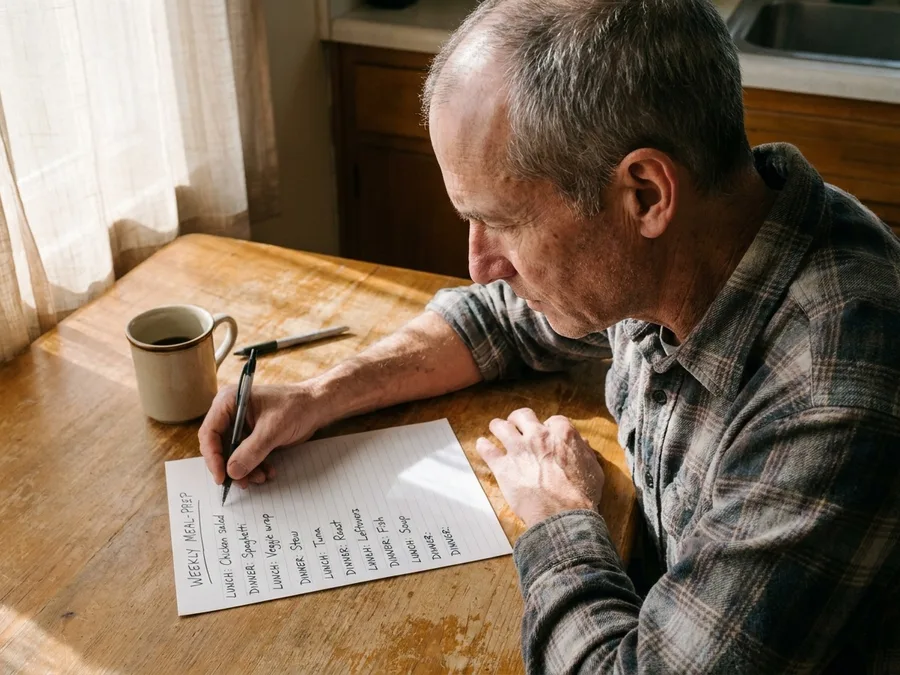
Decide the whole week on paper before you leave the house. Five lunches and five dinners go on one sheet, and only four of those dinners get prepped, with the fifth left blank for whatever the week throws at you. That blank is a decision too, and making it on paper in advance keeps the weeknight from turning it into a scramble.
Pick meals you already make. If Tuesday’s chicken-and-rice has been in the rotation for a year, prep it, but do not use the block to try a recipe you have never cooked: a first attempt eats the two hours in tasting and adjusting, and the containers end up filled with something nobody wants to eat five days running.
The finished list is the target. It tells you exactly what to buy on the $45-$55 run and what the 2-4 p.m. block has to produce, so Sunday is execution, not invention.
Keep the cooking to three things: a protein, a grain, and vegetables. That is the ceiling, because a longer menu will not fit in two hours, and a menu that overruns the block collapses on the first Sunday. Three components across five lunches and four dinners is plenty of variety once sauce and a crunchy topping do their work.
Do this and the weeknight question is already answered before you shop. You do not stand at the open fridge at 6:30 asking what to eat, because the answer was written down days ago.
⚠️ COMMON MISTAKE
Testing a new recipe on Sunday
The most common Sunday meal-prep mistake is trying a recipe you have never cooked. If it fails or takes twice as long, you have burned your two-hour block and lost the week's food. Cook what you already know; save new recipes for a night when a backup is in the fridge.
What do I buy, and how much does it cost?
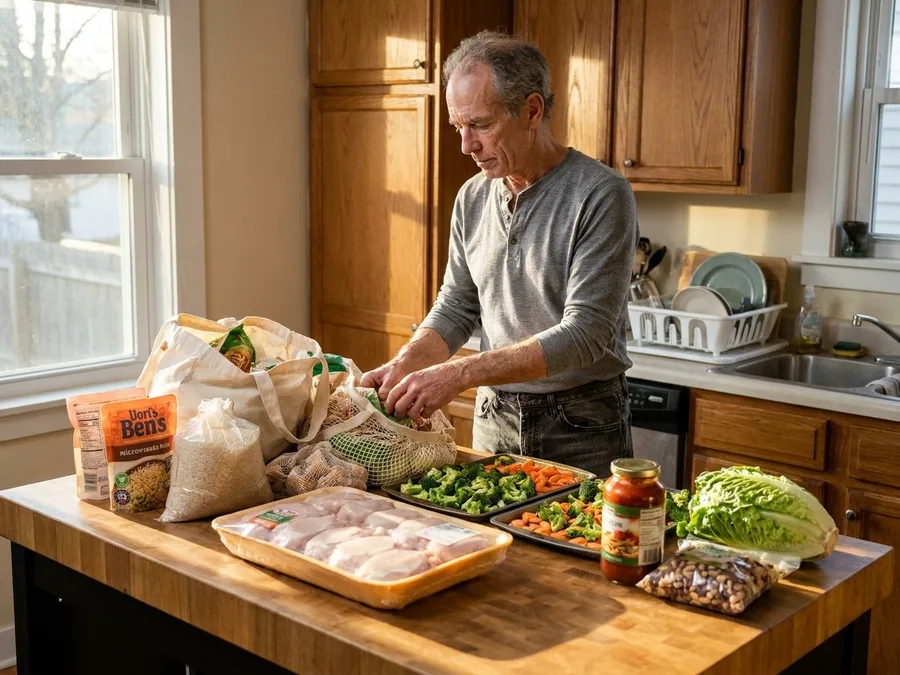
Twelve items, one cart, $45-$55 for one person: that is the whole shop, and it covers five lunches and four prepped dinners. Count them as you load the cart, because the list is closed once you leave the store.
Start with the protein: 2.5 lb of chicken thighs or tofu. Thighs are forgiving at reheat, so they do not dry out by Thursday the way breasts can; tofu holds up equally well if that is your preference.
Then the grain: either 4 cups of dry rice, millet as the grain, or two bags of microwave rice, whichever fits your patience on a Sunday afternoon. The microwave bags are the honest shortcut if the block is already full.
For vegetables, buy enough for two large sheet pans, plus one sauce and one crunchy topping. Those three round out the twelve and they are what keep the same components from tasting like the same meal.
The shop ends the midweek what-to-buy decision. Come Wednesday, there is no second run for one missing thing, because everything the containers need is already in the kitchen. That single trip is where the routine either holds or quietly fails.
The Sunday Budget at a Glance
What does the Sunday block actually look like?
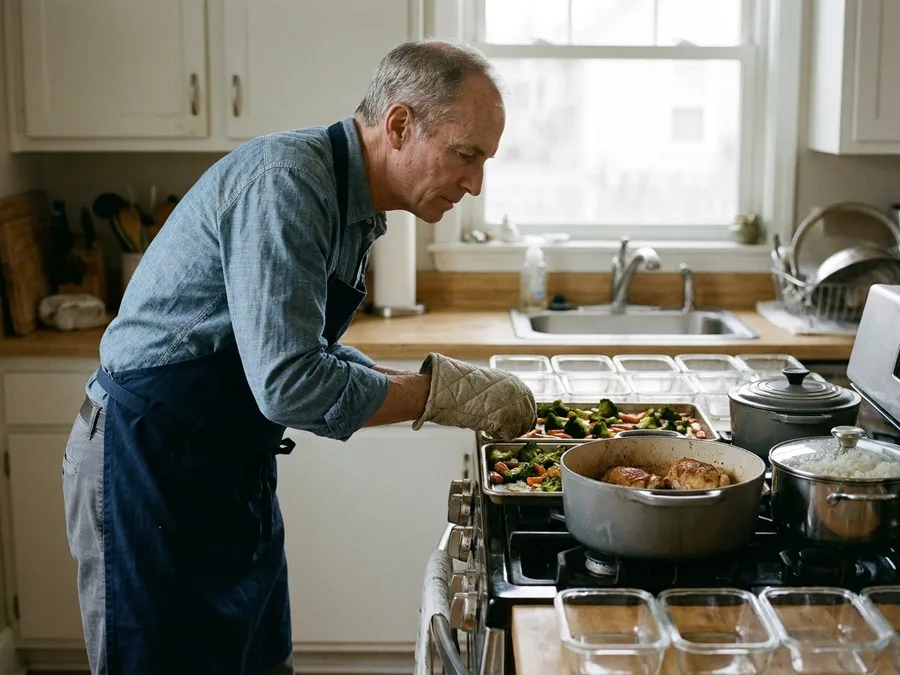
It is one person in the kitchen, 2 to 4 p.m., and the order is fixed so nothing sits and nothing crowds. Start the oven and get both large sheet pans of vegetables in first, because they take the longest and need the most room.
While those roast, put the 2.5 lb of chicken thighs or tofu on the stove. Two things cooking at once is the reason two hours is enough, so resist the urge to do one and then the other.
Then set out the 4 cups of cooked rice and line up the ten 2-cup glass containers on the counter while the components cool. Cooling matters: packing hot food traps steam, and steam is what makes Tuesday’s greens limp.
Cook only protein, grain, and vegetables. The sauce and the crunchy topping remain raw because they are added later and do not belong in the block.
⏲️ The Two-Hour Sunday Sequence
1:50 – Oven preheat
Get the oven to 425°F before 2 p.m. and chop vegetables on one board, separating by density: roots first, soft vegetables last.
2:00 – Sheet pans in, upper and lower racks
Place one pan on the upper rack and one on the lower, then swap racks at the halfway mark; crowding both pans on one rack steams instead of roasting.
2:15 – Protein on, covered
Cover the pan. Chicken thighs need 20-25 minutes until 165°F; tofu needs 15 minutes pressed and browned. Uncover in the last 5 minutes for color.
2:45 – Rice, but not on the stove
Use a rice cooker or a covered pot for the 4 cups dry rice; set a timer and do not stir. Dry rice doubles to about 8 cups cooked, enough for ten 1/2-cup portions.
3:15 – Cool, then stack
Spread components on the sheet pans to cool in 10 minutes flat. Do not lid anything until it reaches room temperature, or condensation ruins Wednesday's texture.
3:45 – Sauce, labels, and the one rule
Portion 2 oz sauce into 2-oz jars, lid, and label each container for its day. Leave one dinner slot empty; the open fifth night is what keeps this from feeling like a diet.
How do I portion for weight loss without weighing everything?

Skip the scale and use the container: each 2-cup glass one gets 3 oz of cooked protein, 1 cup of vegetables, 1/2 cup of cooked rice, and 2 tbsp of sauce.
The 2-cup size is the whole system. It sets the boundary physically, so you never open a calorie app or hunt for the scale buried behind the mixer. Fill to the line, lid on, done.
That matters more than it sounds after 40. Portion drift is the quiet part of weight regain — an extra half-cup of rice here, a heavier pour of oil there — and it happens because nothing in the kitchen pushes back. A fixed container does.
Sauce belongs inside the same measurement, not poured free at the table. Two tablespoons is roughly the difference between a dressed bowl and a bowl of oil, so measure it once on Sunday and skip the dinnertime question.
The same build repeats across five lunches and four prepped dinners. Nine containers, identical proportions, mean your week is set to one target without tracking a single gram on a Wednesday night.
That is the real saving: the how-much decision is gone before the week starts.
Weighing Every Meal vs. Hand Portions
Weighing and tracking
- Requires a scale, an app, and a decision at every meal
- Works until the week gets busy and logging stops
- Precise on paper, fragile in practice
- One skipped entry turns into a lost week
Hand portions in 2-cup containers
- One decision on Sunday, repeated all week
- No scale, no app, no logging
- The container sets the boundary automatically
- Missed day? The next container is still there
How do I keep five days of food from getting soggy?
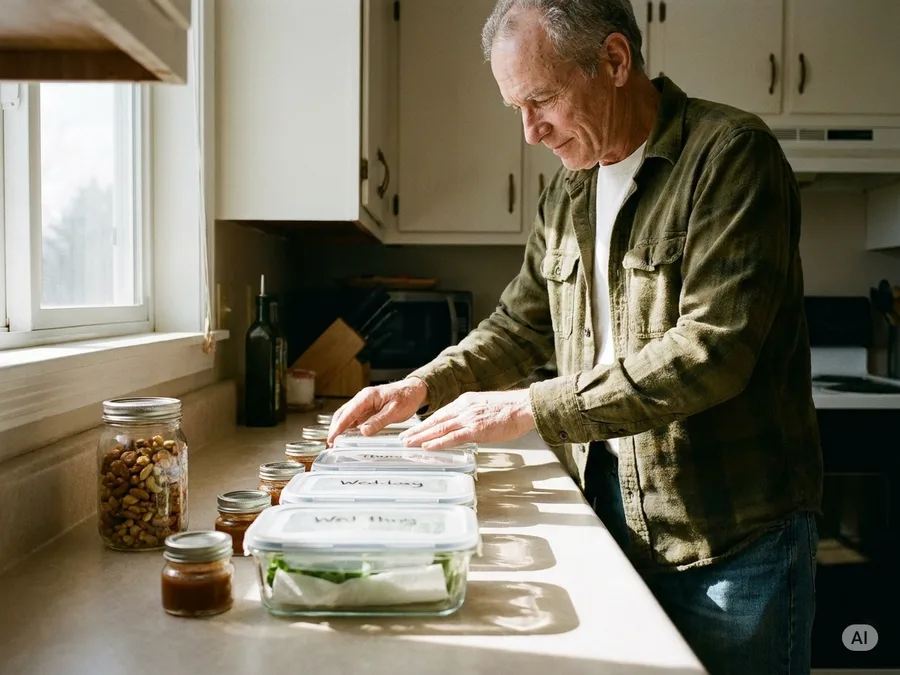
Sauce and crunch stay in their own containers until the moment you eat, and the food underneath stays crisp for five days.
Portion the sauce into 2-oz jars, one per meal. Five days is long enough for dressing to soften vegetables and turn a grain bowl to mush, so the jar is what keeps the sauce from doing that work early.
Greens are the other weak point. Store them dry, with a paper towel in the container to absorb condensation, wet leaves wilt fast, and a slimy handful on Thursday undoes the whole point.
The crunchy topping stays completely dry in its own small bag or jar. Add it the morning you plan to eat that container, not Sunday, or you will be chewing damp nuts by midweek.
Label each lid by day. It sounds fussy until the first Wednesday, when you are tired and reach for whatever is in front and open Thursday’s lunch by mistake. The label is a two-second fix.
💡 PRO TIP
Label by day, not by food
Write Monday through Friday on the lids with a strip of masking tape and a marker. Writing the food name feels useful on Sunday and useless by Wednesday. The day label is the only one that changes a decision.
What does lunch and dinner look like Monday through Friday?
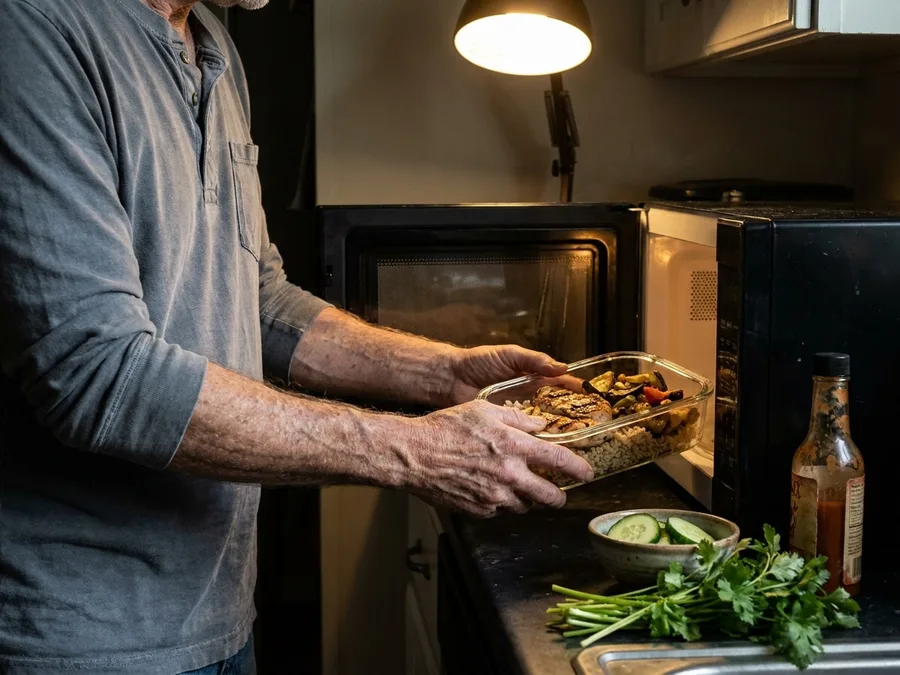
Monday through Friday, a meal is reheat two to three minutes, spoon on the sauce, add the fresh crunch, eat. It is not cooking.
One container is lunch. A second container is dinner. That is the entire weekday menu from Monday through Thursday, and Friday dinner is the open slot.
The fresh add-on is what keeps it from tasting like the same bowl five times. Cucumber, a handful of herbs, a hit of hot sauce — put it in at eating time so it stays bright, not steamed into the rice.
That means five lunches and four prepped dinners carry the full workweek. You are not deciding what to cook and you are not cooking; the container is already the meal.
The two hours on Sunday exist to buy back exactly this — a Tuesday night with no pot to wash and no menu to solve.
Reheat time is short on purpose. Two to three minutes is enough to warm the protein and rice without drying out the vegetables, which is the failure mode of a five-minute microwave blast.
Sunday Routine Scorecard
What happens when the week goes off plan?
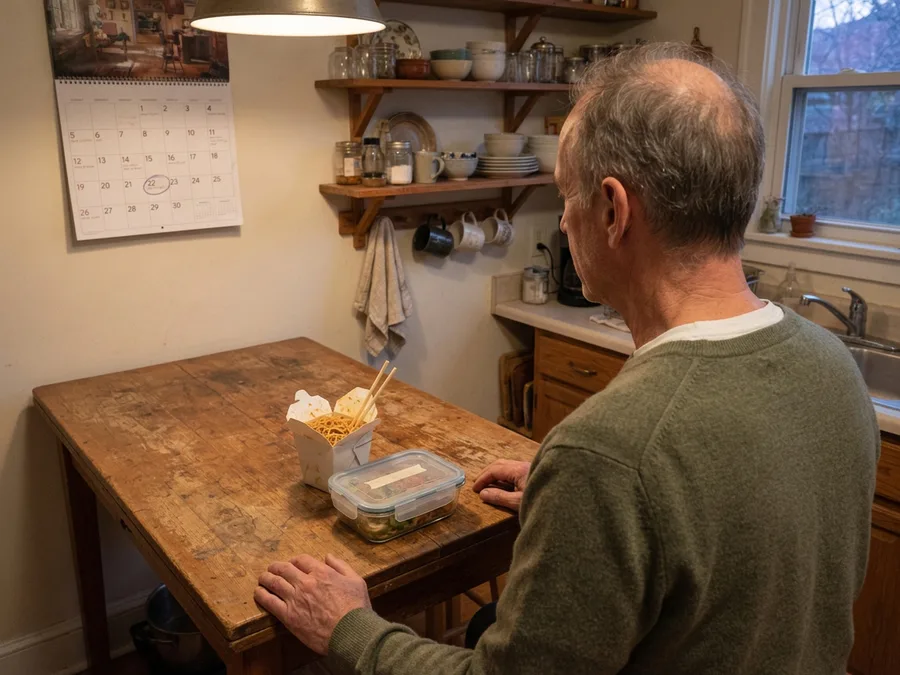
One of the five dinners is deliberately left unplanned, and that empty slot is what keeps the other nine containers from becoming a guilt pile by Friday. The open slot is where takeout, leftovers, or a dinner out with friends lands, and it was built into the count before the grocery list was written, so nothing about it is a surprise.
Dinner with friends on Wednesday does not break the week. It fills the open slot, which means the other nine containers still match the days they were labeled for, and Thursday’s lunch is still sitting there untouched.
Say a day gets away from you anyway, because one will. The next meal is simply the next labeled container in the stack, not a fresh start on Monday and not a reason to write off the rest of the week.
This is the quiet mechanism behind the whole framework: a missed day costs one meal, while an all-or-nothing mindset costs the week. The container you skip on Tuesday does not spoil the one labeled Thursday. Nothing has to be reset, replaced, or repurchased.
The same frame repeats next Sunday without any rethinking on your part: five lunches, four dinners, one open slot, a twelve-item shop, and the 2-4 p.m. block. Repeat it enough times and the open slot stops feeling like a break from the plan. It becomes the part of the plan that makes the other nine containers survive the week, which is exactly the capacity it was always meant to hold.
This Sunday: write the list, shop the twelve items, block 2–4 p.m.
The verdict is yes, the two-hour block is worth it, but only because of what it removes. It makes five lunches and four dinners automatic, it fixes the portion before the week starts, and the open dinner slot is deliberate capacity, not slack in the plan.
So the first action is this Sunday, and it is small: before you shop, write the five lunches and five dinners, four of them to prep and one left blank. Then buy the twelve items for $45-$55. Then block 2 to 4 p.m. and cook three components, protein, grain, vegetables.
Tuesday will still arrive, and the collapse that usually happens at 6:30 will already have been handled, because the menu, the shop, the cooking, the portioning, and the packing all happened Sunday. The open dinner slot is part of the plan, not a failure, and the same frame runs again next Sunday without a Monday restart. Write the list this week.
Start with the list this Sunday
Write five lunches and five dinners, shop the twelve items, and block 2–4 p.m. The open dinner slot is already in the plan.
