

Can you really lose weight without giving up the foods you love? That is the exact question you typed, and here is the short answer: yes, as long as you accept that nothing is free.
Think about how the last three diets ended. Not with a bang, usually, but with a quiet Thursday night when the takeout menu came out and the whole thing collapsed in about eleven minutes.
The restriction was never the hard part in week one. It was week five, when the pizza you were not allowed to eat became the only thing you could think about.
So this article does not hand you a ban list. It hands you a price list. Every food you love stays on the menu, and each one carries a calorie cost that comes out of the same daily total as everything else.
A typical desk worker at 5’8″ and 190 pounds maintains on roughly 2,300 calories a day; eating about 1,900 opens a 400-calorie daily gap, which works out to about 0.8 pounds a week. That gap, not the ban, is what moves the scale.
Quick Tips Before You Start
Count, don't cancel
One over-budget meal spends tomorrow's gap; it does not erase the week.
Change the company
Keep the pizza exactly as it is and add a salad and a palm of protein beside it.
Fix drinks first
Liquid calories are the cheapest room to find, because you miss nothing edible.
Plan the treat by noon
A dessert decided early and counted is a line item, not a slip.
Judge by the weekly average
One bad weigh-in means nothing; four flat weeks mean something specific.
1. A small calorie gap does the work

The calorie deficit produces the weight loss, and a deficit does not care which foods close it. Nothing is off-limits here, and nothing is free either. Every food carries a price, and every price gets subtracted from the same daily total. That single rule is the whole engine, and once the reader understands it, the question of whether pizza and the ice cream bar can stay in the week has a plain answer: any favorite is affordable inside the number, if the room for it comes from somewhere else.
The arithmetic is the answer. A 5’8″, 190-pound desk worker who maintains his weight on about 2,300 calories a day simply eats about 1,900, and the 400-calorie gap between those two numbers is roughly 0.8 pounds a week of loss. No food list, no ban, no separate rules. That gap is the entire mechanism, and it is the reason the rest of this approach is about making room rather than removing anything.
The two-slice pizza at 620 calories and the 350-calorie breakfast sandwich count exactly the same way. Each is a number subtracted from the 1,900. Keeping the pizza costs room elsewhere in the day; it does not buy an exemption from counting. This is the part that trips people up, because a favorite food feels as though it should sit outside the ledger. It does not. It sits inside it, priced like everything else.
Watch what happens after one over-budget meal, because this is where most attempts collapse. The reflex is to think the week is ruined and abandon it. It is not. One heavy dinner spends the next day’s 400 calories, and the week still closes in the negative if the rest of the days hold. The week is the unit of measurement, not the meal.
💡 Tip: Estimate maintenance at roughly 14 calories per pound of body weight for a moderately active adult, then subtract 300 to 500.
| Swap | Usual calories | Replacement calories | Calories saved |
|---|---|---|---|
| 20 oz regular soda | 240 | 0 (seltzer) | 240 |
| Afternoon bag of office pretzels | 200 | 130 (plain Greek yogurt) | 70 |
| Two pepperoni slices | 620 | 310 (one slice) + 200 (grilled-chicken salad) | 110 |
2. Shrink the portion, keep the food
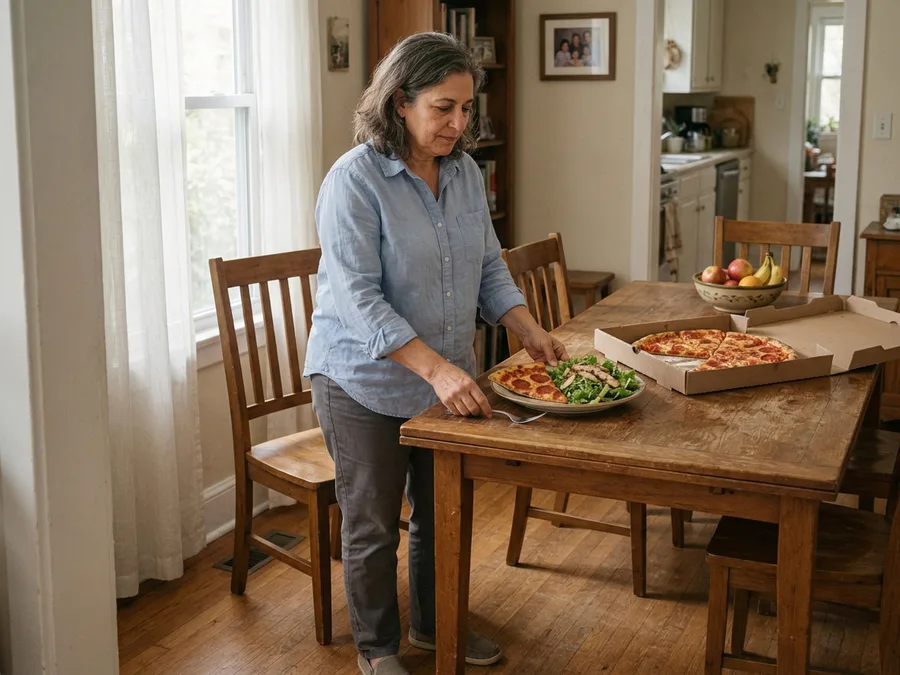
The pizza itself is usually the biggest single line in the day, so the first place to find room is inside the portion, not on the other side of a veto. Old approach: a full pizza night you felt you had to earn. New setting: two pepperoni slices, 620 calories – becomes one slice for 310, with a 200-calorie grilled-chicken salad on the same plate. That is 110 calories saved and a fuller plate of food than the two slices alone. The pizza is still on the table. Only the second slice is gone.
Volume does the real work here. Vegetables and lean protein take up space on the plate and space in the stomach, and that is what turns a single slice into something that reads as dinner rather than as a punishment. A one-slice lunch on an empty plate feels like being shortchanged. The same slice beside a mound of greens and a few strips of chicken feels like a meal.
It does not suit the reader who reliably eats four slices the moment the box is open. That reader is not portioning. They are triggering, and one slice on the plate simply wakes up the appetite for the rest of the pie. The better answer for them is a test that starts later in the day, not this serving trick.
The point for the reader still at the pizza stage: the slice stays priced at 310 and the room to keep it comes from the salad side of the plate, not from crossing pizza off the list. One slice is now a line item in the same 1,900 the rest of the day runs on, and it fits without ceremony.
💡 Tip: Serve the pizza onto a plate in the kitchen and put the box away before you sit down. The box on the table is a second helping with no lid.
At a Glance
3. Budget the treat before the day starts

Give the dessert its own line in the day’s total before the day begins, and it stays in the plan without wrecking it.
Shrinking the portion handles the meal. The dessert and the snacks get decided at other hours, often in a kitchen at 8pm or at a vending machine at 4pm, so they need to be planned in advance rather than negotiated in the moment. The nightly 150-calorie ice cream bar goes into the 1,900 like a line item, sitting right alongside the 350-calorie breakfast sandwich and the 80-calorie coffee with cream. It is not an exception. It is budgeted.
The counted 150 replaces the unplanned snack rather than stacking on top of it. If the pretzels were going to happen at the office anyway at 200 calories, the ice cream bar comes out of that same room. The total does not grow, the food just moves to an hour you actually look forward to.
Keeping the ritual, the same food at the same time of night, is what carries the plan past week three. A day that still contains the thing you wait for all day is the reason you do not quit it.
💡 Tip: Buy the single-serve box, never the family tub. A pre-portioned bar ends the argument before it starts.
⚠️ COMMON MISTAKE
Saving calories all day for one big night
Skipping breakfast and lunch to bank 900 calories for a restaurant dinner usually backfires: you arrive ravenous, order past the budget and finish the bread basket before the mains. Eat a normal breakfast and a protein-led lunch, then spend the dinner budget from a place of control.
4. Protein and fiber keep hunger quiet
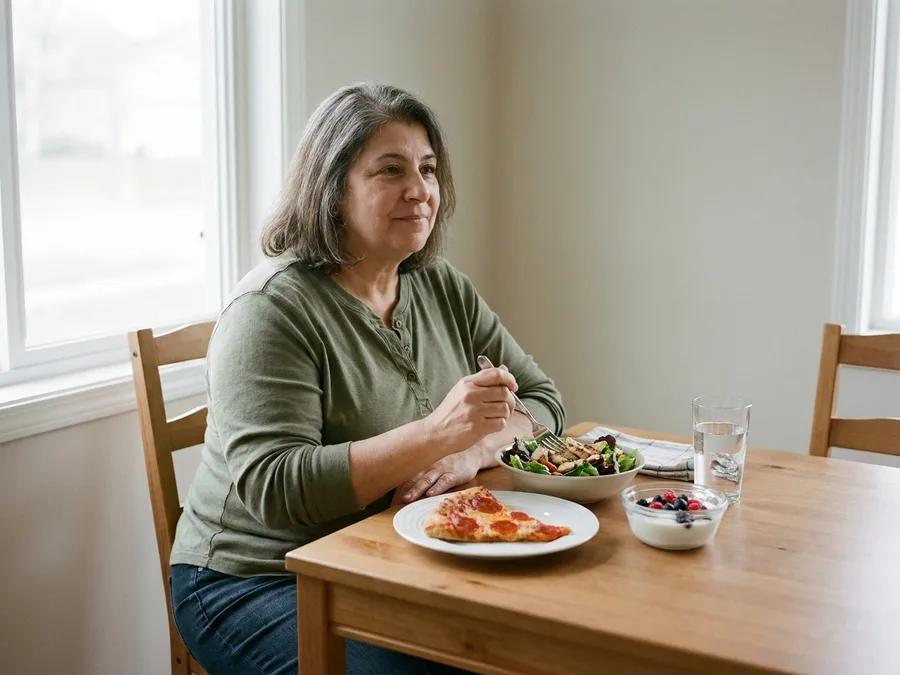
The favorite food is rarely what leaves you hungry at 3pm. What sits next to it decides that, and it is the piece that makes a smaller portion and a planned treat survive the afternoon.
a palm-sized portion of protein and a fist of vegetables at every meal, put down beside the food you actually wanted. The favorite stays untouched.
A 620-calorie pizza eaten alone at noon sends most people back to the fridge or the vending machine by mid-afternoon. The same pizza with a 200-calorie grilled-chicken salad on the side does not.
Nothing about the pizza was fixed. The salad is not standing in for it — it is the reason you are not buying a second meal four hours later.
The same rule applies to the small stuff. Swap the 200-calorie bag of office pretzels for 130 calories of plain Greek yogurt and you have saved 70 calories and bought yourself an extra hour before hunger shows up. Protein does the work refined starch cannot.
This is not a section about cauliflower crust or low-fat cheese. The food you love is never modified here — only the company it keeps at the meal. The pizza still costs 620 calories and it is still in the day.
💡 Tip: Keep a tub of plain Greek yogurt and a bag of frozen berries in the office fridge. That is the 3 p.m. problem solved before it happens.
The 400-calorie gap: what holds it and what eats it in one go
Stays inside the 1,900
- Seltzer from the 20 oz bottle: 240 calories removed
- One slice plus the 200-calorie salad: 310 removed
- Greek yogurt at the desk: 70 saved and hunger held an extra hour
- Breakfast sandwich, cream in coffee, nightly 150-calorie ice cream bar – no change needed
- Ice cream eaten as the final meal, after protein, not as the 3pm reach
Wipes all three swaps
- Two IPAs or a large margarita: 400-500 calories, the whole gap gone
- Family-size chip bag eaten from the bag: roughly 1,200 calories
- Single-serve 150-calorie bags: noticeably more per ounce, but they stop at the bag
- Treat counted as a swap when the salad was left on the plate
- Weight averaged weekly, flat three to four weeks: portions change, not the food
5. Drinks can erase the whole gap

A drink counts toward the daily total exactly like food does, and it is where a carefully portioned day most often comes apart in a single glass.
Twenty ounces of regular soda carries 240 calories, which is well past half of the 400-calorie gap the whole week is built on. It arrives cold, in a cup, over ice, and it never once feels like a meal.
That is the trick of it. Nothing edible has been eaten, so the day feels untouched, and yet the room that was supposed to hold a slice of pizza is already spent.
Alcohol behaves the same way but in a higher bracket. Two IPAs or one wide margarita in a salted glass on a Friday night runs 400 to 500 calories, which is the entire daily gap swallowed in a single sitting on the sofa.
One evening out can therefore flatten six careful days of arithmetic, and the scale on Monday morning looks like a mystery when it is only a receipt.
The swaps here are close to free. Seltzer with lime in place of the soda, a diet soda, black coffee, unsweetened iced tea: the 240 drops to zero and nothing that is eaten leaves the week at all.
For the drinker, this is the single cheapest lever on the list. Not one favorite food has to move.
There is a second bill that alcohol runs, and it does not appear on the tab. After two drinks the odds of stopping at one slice when the pizza box opens drop sharply, so the calories logged in the glass are rarely where the accounting ends.
If the current routine is already water and coffee and the scale still has not moved, the drinks are not the leak. The room has to come out of portions of food instead, and that is a food problem rather than a beverage one.
💡 Tip: Set the alcohol budget in drinks per week, not calories. Two drinks, twice a week is easy to hold and easy to count.
Two Fridays, One Gap
What each night costs against the 400-calorie daily target
Percentages compare total evening calories; the gap is 400. Your portions will shift the numbers — the ordering will not.
6. Keep the foods you can’t moderate out
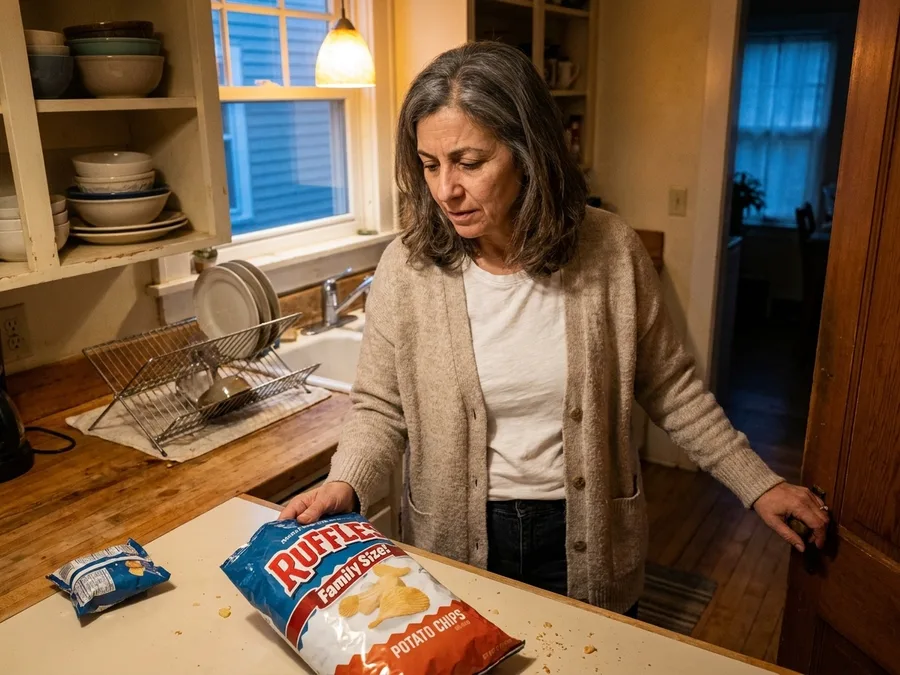
Some foods are not portion problems at all, and for those the fix is not a smaller bowl but an empty shelf, because stopping once the bag is open is not a decision that can be made reliably.
Picture a family-size bag of chips on the counter on a Tuesday night. Eaten straight from the bag while the television is on, it holds roughly 1,200 calories, which is most of a week’s 400-calorie gap gone in twenty minutes without a plate ever being used.
The single-serve bags that hold 150 calories cost noticeably more per ounce, and that premium is worth paying. What is being bought is one decision at the shop instead of a fresh argument with the bag every night for the next month.
Resisting a food that is already in the cupboard means making that choice again and again, and a person loses one of those rounds eventually. Not buying it is a single choice made in an aisle, with shoes on and no appetite, and it holds for the whole week.
The scope matters here. This is about one or two specific foods, not the whole pantry, because a kitchen stripped of anything enjoyable is precisely the restriction that already collapsed once.
The two-week test settles it without guesswork. Keep the food in the house for fourteen days and write down each time the eating actually stopped at a single serving, because the tally is the answer and the intention is not.
💡 Tip: Don't stock the trigger food "for guests." Guests come twice a year; you are there every night.
7. Know when to cut a food temporarily

Something has to come out only when a food has stopped being a portion and started being a decision you lose every night, and even then the exit is a scheduled one with an end date written on it.
Start with the scale, because the scale is where most people panic too early. One bad Monday morning weigh-in means nothing. Weigh yourself daily if you like, but judge the trend by the weekly average, and only act when that average has sat flat for three to four weeks while the portions you set are still the portions you are actually eating. Half a pound up on a Thursday is noise. Four flat weeks is information.
When it does, the cut is one food, held out of the house for four to six weeks, with the retest date marked on the calendar before you start. Not a food group, not a list, not forever. A permanent ban is the thing that ended the last diet, and it will end this one too.
I have watched people treat one failed food as proof the whole approach is broken. It is not. The other favorites stay exactly where they were: the single slice at 310 calories and the 150-calorie bar at nine at night are still in the week throughout the cut, untouched. You are removing one item from a shelf, not clearing the shelf.
One caveat that deserves a straight sentence. If you have a history of disordered eating, or the cut you are considering would drop your intake below a sensible level for your body, take this decision to a clinician or a registered dietitian instead of making it alone at the kitchen counter.
💡 Tip: Pick the single food you already know is the problem. If you have to think about which one, the two-week test from item six will tell you.
📋 The two-week test, start to finish
Pick one food
One, because two running at once makes the counts impossible to read.
Keep it in the house
Same shelf, same supply. Hiding it changes the test, not the habit.
Count the wins
A win is stopping at your stated serving, weighed or poured, not eyeballed.
Count the losses
A loss is eating past the serving, or eating from the container by habit.
Read the count, not the intention
Mostly wins means it stays; repeated losses mean it leaves for now.
Set the route
A failed food leaves, but you only remove the one item, not the shelf.
Swap the soda first, and let the ice cream bar stay
Swap the soda first. Dropping 240 calories to zero costs nothing you will miss, while the pizza at one slice asks something real of you – start where the change is free and work outward from there.
The signal to move from moderating to cutting is specific: the food fails the two-week test, or the weekly average sits flat for three to four weeks with portions held. Then one food comes out for four to six weeks and gets retested against the count. The previous diets ended because the loved foods were removed. This plan is arranged so that ending is never forced.
The 150-calorie ice cream bar staying in the 1,900-calorie day is the plan working, not a cheat. So back to the question you started with – can you lose weight and keep the foods you love? Yes: pay the soda’s rent, keep the ice cream bar, and let the pizza stay at one slice.
Price your Friday tonight
Write down what your usual Friday actually costs in calories, then find one swap that keeps the evening and shrinks the bill. The table in this article is the place to start.
