
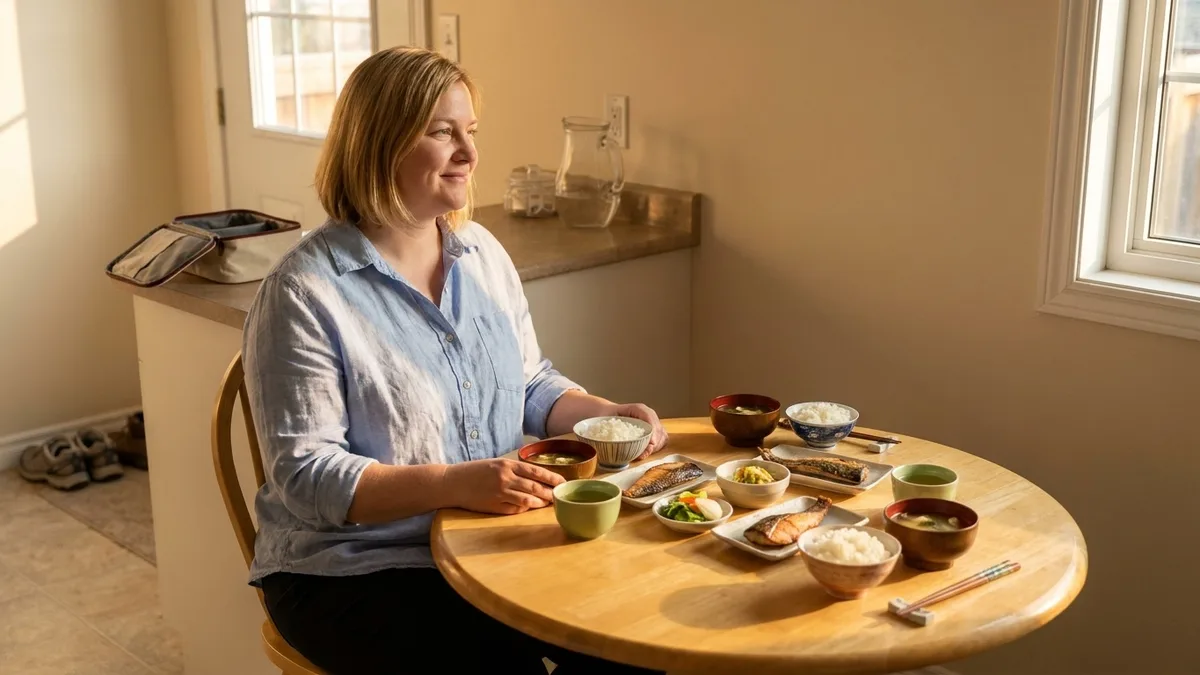
The alarm goes at 5:15. Tea, a lunchbox, someone else’s lunch, breakfast, dishes, laundry, sweeping, mopping. By eight in the morning she has not taken five minutes for herself.
Then she sits down, switches on the TV, and there is a street in Japan where nearly everyone is slim. Commuters, teenagers, old men on bicycles. She looks at her own back and asks the question out loud: I’ve been running since dawn, so why am I the one gaining weight?
Here is the short answer. Japanese eating habits for weight loss have almost nothing to do with willpower, and nothing at all to do with a secret food. They are eight small habits, and every one of them can be bolted onto an ordinary kitchen.
You will not need a gym membership, a supplement, or a single item that isn’t already in your grocery basket. Start with number one and build outward.
Quick Tips Before You Start
Phone out of reach
Leave it charging in another room before bed so the first ten minutes of the morning stay yours.
Switch to a smaller plate
Swap your dinner plate for a side plate once, tonight, and see how the same meal looks on it.
Time one meal
Clock a normal meal. If it's over in eight minutes, that's the habit to work on first.
Two floors of stairs
Take the stairs for two floors, not all of them. That's the version you'll actually keep.
Keep green tea in the cupboard
Ordinary loose-leaf green tea, nothing fancy. It's your stand-in for the evening fridge visit.
Bed half an hour earlier
Set a phone reminder thirty minutes before your usual bedtime and treat it as a real appointment.
1. Busy all day isn’t the same as healthy

By eight you’ve worked a full shift and earned none of it. That is the trap. Being on your feet from 5:15 to 8 is work, and work makes you tired, but tired is not the same as healthy.
You can be exhausted and still have spent most of the day standing in one kitchen, eating whatever fits between two tasks. That’s why the 5:15 alarm and the eight o’clock sit-down explain the weight gain better than any lack of effort does.
And when you finally sit, the TV shows a Japanese street where commuters, teenagers, even the elderly, all look slim. The answer to that is not more discipline. It’s a handful of habits, copied from a country that made them ordinary.
💡 Tip: Pick your habits from a list of swaps, not from a list of rules. Swaps are things you do instead. Rules are things you fail.
| Moment | Running on empty | The Japanese habit |
|---|---|---|
| 5 a.m. | Checks the phone in bed | Opens the window, sips warm water, sits quietly for ten minutes |
| Breakfast | Eaten standing at the counter, under ten minutes | Half a cup of rice, small miso soup, palm-sized fish, pickles, over twenty minutes |
| Fullness | Clears the plate before the brain catches up | Stops at about 80% full and leaves a few bites |
| Getting about | Lift, car, seat | Twelve-minute walk to the station, four flights of stairs, a twenty-minute walk to the market |
| 6 p.m. | Opens the fridge for something sweet | Brews green tea, sits on the balcony, breathes slowly for five minutes |
2. A quiet first ten minutes protects the whole day

Probably more of the day than anything else on this list. At five in the morning, a Tokyo woman wakes and doesn’t touch her phone. She opens a window, lets the cold air in, drinks a glass of warm water slowly, and sits without saying a word for about ten minutes.
No detox drink, no magic powder. The water isn’t really the point. The calm is.
Your brain is at its most sensitive right after waking. Start it with stress and notifications and it tires faster and reaches for comfort food sooner, so the weight gain often begins in your head, not your kitchen. You are not weak at 6 p.m. You were set up at 6 a.m.
The catch is the phone. If it’s on the nightstand, this habit fails by day three. Leave it charging in another room. And if a child or a shift wrecks the quiet, take the ten minutes later – at the sink, the bus stop, even a locked bathroom – and count it.
⚠️ COMMON MISTAKE
Don't cook a separate diet meal
One person eating different food from the family rarely survives a busy week. Change the plate size, the serving spoon and the speed instead, and everyone eats the same dinner.
3. Eat to 80% full, before the brain catches up
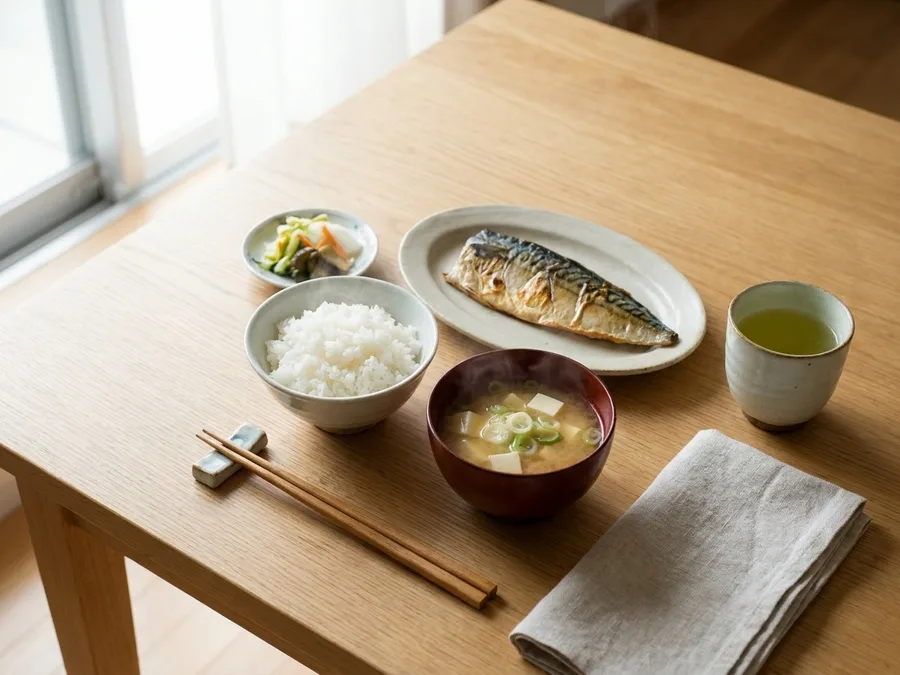
The morning sets you up, but eating slowly is not dieting – it’s eating less without noticing, which is why it works where willpower doesn’t. Picture the breakfast instead of the crash diet: half a cup of rice in a small bowl, a small bowl of miso soup, a palm-sized piece of grilled fish, a few pickles and vegetables. Nothing is banned. There simply isn’t a mountain on the plate.
In Japan this is called hara hachi bu – stop when you’re about 80% full. Your brain takes roughly twenty minutes to register fullness, and most of us finish a meal in eight to ten. Slowing down at meals builds the small pauses where fullness actually registers before the plate is empty. So we overshoot the signal every single time, then wonder why.
Mindless eating makes it worse. Standing at the counter, phone propped on the jar, TV on – you finish and honestly can’t recall what went in.
You don’t need a scale to find 80%. Use a smaller plate. Eat until you’re no longer hungry rather than until you’re full. Put the fork down between bites. It’s a habit to build, not a portion rule to obey.
💡 Tip: At home, serve the food already plated and leave the rest in the kitchen. The pot on the table is what gets refilled.
💡 PRO TIP
Set a twenty-minute timer
The brain needs about twenty minutes to register fullness, so give it the time. Put a timer on the table, eat one meal at that pace, and notice the moment you would normally have stood up for more.
4. The day stays active without a single gym visit

That brings you to the moment you get home, kick off your shoes and decide you’re too worn out to move – except her week has no gym in it at all. She walks twelve minutes to the station, takes four flights of stairs instead of the escalator, walks twenty minutes to the market, and does the small jobs around the house by hand. Nothing on that list looks like exercise. Together, it’s a working day in motion.
The science calls it NEAT – the calories you burn through small daily activity rather than workouts. It’s the difference between a body that moves a little all day and one that moves hard for forty minutes and then sits for nine hours.
Here’s the realisation worth keeping: feeling tired all day while seated all day is mental fatigue, not movement. They are not interchangeable.
Say you’re a desk worker or a caregiver. Don’t chase a step target. Get off one stop early. Take the stairs for two floors, not seven. Do one errand on foot. Ten to fifteen minutes at a time is plenty.
None of it costs a penny, and none of it needs washing gym clothes after.
5. The evening fridge search is usually stress, not hunger

And after a day like that, the fridge door gets opened at six, looking for something sweet. That feeling is usually not hunger, it’s stress. Back home from work, tired and wired, a Tokyo woman doesn’t reach for the biscuits. She brews a pot of ordinary green tea, sits on the balcony and takes slow breaths for five minutes. She has taught her brain a second way to take the edge off.
Sugar lifts dopamine for a few minutes, then it drops and the brain asks for more. That loop is how the weight creeps on.
The swap feels flat at first, because tea is not a reward. Give it a week of evenings before you decide it doesn’t work – and keep a backup for the nights it doesn’t, like a warm shower or a phone call with a friend.
Before You Start Swapping
-
Charge your phone outside the bedroom tonight This is habit number two, done in advance.
-
Put one side plate on your usual shelf Smaller plate, same food, no measuring.
-
Find your loose-leaf green tea or buy one box Ordinary green tea is enough, nothing premium required.
-
Time one normal meal, start to finish If it's under ten minutes, that's your number to beat.
-
Choose one walk you already make and extend it One stop early, or the far entrance of the market.
-
Set a bedtime reminder thirty minutes early Short sleep makes the whole list harder to keep.
6. Tiny changes beat crash diets and gym memberships

Small swaps, taken one at a time, change how much you eat inside a week and how your clothes fit inside a month. That’s the whole promise, and it’s not a sales pitch.
Here’s the list, and it fits on one line: no phone or TV while you eat. A smaller plate. Eat slowly. Stairs instead of the lift. A short walk instead of a ride. Bed a little earlier. No crash diet, no gym membership, no supplements, no special foods. Nothing on that list adds a single pound to your grocery bill, which matters more than most advice is willing to admit.
The timeline as it actually goes: nothing changes on day one. By the end of week one you’re eating less without trying, mostly because you’re not eating in front of a screen. By week four your clothes feel looser. That’s a month of doing very little, which is exactly why it lasts.
Now the honest part. Don’t start all seven on Monday. You’ll hold them for four days and lose the lot by Friday. Pick one, keep it for a week, then add the next. The goal is keeping them, not starting them. Try it with the stairs first, since it needs no willpower at all once you’ve decided.
Two kinds of reader this won’t suit: the one who needs the scale to move in week one, and the one who treats that list as a checklist to finish rather than a sequence to build.
What actually changes the result
Builds a habit
- One swap held for a full week
- Small plate, fork down between bites
- Stairs for two floors, every time
- Tea on the balcony at six
- Phone charging in another room
Usually collapses
- Seven new rules starting Monday
- No phone, no TV, no sugar, all at once
- Gym membership bought in January
- Replacing dinner with a drink
- A 30-day plan with an end date
7. The habits work because the environment makes them easy
Think of the moment you watch the same street scene again and finally see it properly. Not the bodies this time. The habits.
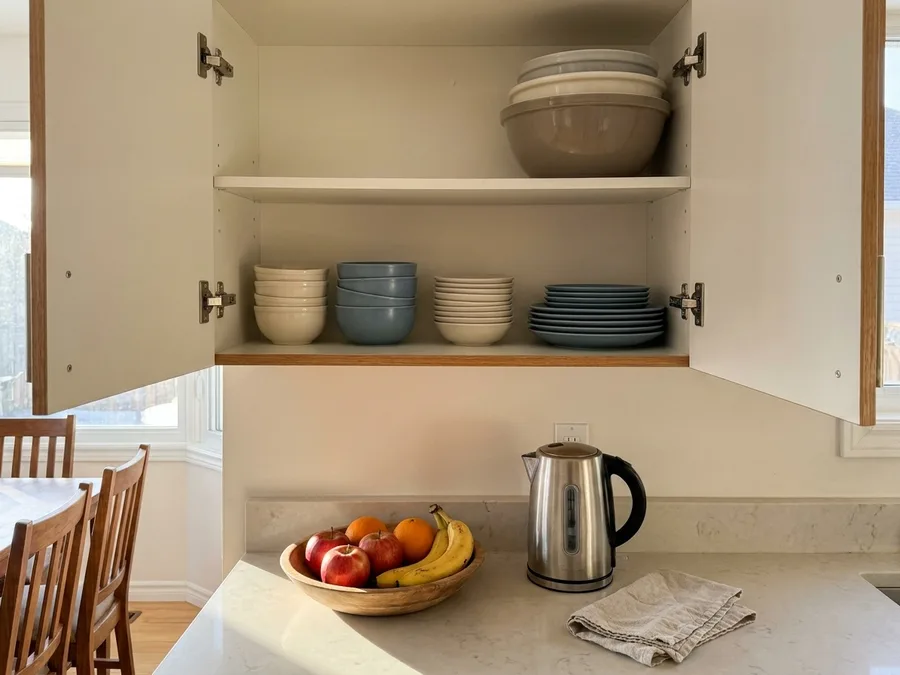
Nobody on that street is running on daily motivation. There’s no secret diet, no food you’ve never heard of, no thirty-day challenge. They’ve arranged their lives so the right choice is the easy one, and then they’ve stopped thinking about it. Slimness isn’t a personality trait; it’s a kitchen with small bowls on the low shelf and snacks in a cupboard rather than on the counter.
So copy that instead of copying a diet. Change where the plates live, where the biscuits are stored, and what you see first when you open the fridge. A fruit bowl within arm’s reach beats a rule you have to remember every evening.
Willpower had nothing to do with it. That’s the whole trick.
The words that come up in every Japanese food story
Learn the four and the rest of the advice is easy to follow.
8. Health is hundreds of small decisions, not one transformation

You don’t need a big transformation to change your health. You need tomorrow’s small decision to be slightly better than today’s.
Habits move first. The body and the day follow slowly, and then one morning your waistband sits differently and nothing dramatic happened to cause it. That’s the part the before-and-after photos never show you, because a photo album can’t sell a Tuesday.
Health is not a challenge with an end date, and the finish line isn’t a number on a scale. It’s the ordinary Tuesday where you eat sitting down, take the stairs, and go to bed half an hour earlier without negotiating with yourself. A thirty-day challenge ends on day thirty-one. This doesn’t.
Which is why the next step isn’t a new plan. It’s week two: keep the one swap you started, and once it runs without you thinking about it, add the second. The body catches up on its own time.
When progress stalls after the first month

Month one is generous and month two is not. Your clothes loosen in the first four weeks, then the scale sits still, and the temptation is to decide it’s all stopped working.
It’s normal, and it isn’t failure. It’s also not the moment to bolt on five new rules and start again from scratch.
Do an audit first. Which swap quietly slipped? It’s usually the screen at meals or the six o’clock fridge visit, because those two need a decision in the moment whereas stairs and small plates run on their own. Put one back before you change anything else.
Then add movement rather than subtract food. One extra ten-minute walk. One more flight of stairs. One errand done on foot. Subtracting food makes you hungry, and hungry habits have a short shelf life.
There are times to stop self-adjusting and see a doctor: unexplained weight change, an existing thyroid condition, or a medication that affects appetite. That isn’t a habit problem, and no amount of green tea will fix it. Check with your doctor before you change anything else.
Getting the family on board without cooking twice

You can follow all of this without giving up your normal home cooking. Nothing here asks you to swap rice for salad or cook one person a separate meal.
Keep the household’s ordinary food and change three things: the plate size, the serving spoon, and the speed. Serve from the kitchen instead of putting the dishes on the table, so a second helping takes a decision rather than an arm’s reach.
Household snacks are easier to manage by location than by rules. Keep them in a closed cupboard rather than on the counter, and bring them out at set times instead of leaving them in view. No lectures needed, and nobody has to feel watched.
The one thing to avoid is the separate diet meal. It rarely survives a busy week, and the moment dinner becomes a chore, you’re back at the counter eating whatever’s quick. If the family eats the same food, only slower and from smaller plates, you’ve already won most of it.
Your first week: one swap, held properly
If you take one thing from all eight, take this: pick a single swap and hold it a full week before you add a second. The best starting pair is the phone charging in another room, so the first ten minutes of the morning stay yours, plus one meal a day eaten sitting down with no screen.
Which swap first depends on your day. Desk-bound? Take the stairs for two floors and get off one stop early. Caregiving or running a household? Change the plate size and eat sitting down. One family meal you all share? Serve from the kitchen and leave the dishes off the table.
Week one will feel like nothing. Week four is when the waistband says otherwise.
Start with the phone, tonight
Charge it in another room before bed. Tomorrow morning, take ten quiet minutes and eat one meal sitting down with no screen. Hold that for seven days before adding anything else.
