

Picture a school cafeteria in 1975. A shopping mall on a Saturday. A crowded beach. Nobody is fat. Not the moms, not the dads, not the teenagers.
An entire country is eating white bread, butter, red meat, and drinking Coca-Cola, and almost none of them are counting a single calorie. In 1970, about 13% of American adults were obese. Today it’s 42% — nearly triple in 50 years.
Not with a magic food or a forgotten workout, but with a thousand small defaults that made overeating inconvenient and moving unavoidable.
You’ll see exactly what changed, why nobody was more disciplined back then, and which of those defaults you can honestly rebuild now.
Obesity Nearly Tripled in Fifty Years

In 1970, about 13% of American adults were obese. Today, it’s about 42%, nearly triple what it was in fifty years.
That number is the whole puzzle, and it’s bigger than you probably think. This isn’t a rounding error or a quiet shift in how obesity gets measured. It’s a whole population transforming, and it happened in roughly half a century. A country of over 200 million people doesn’t collectively lose willpower on a Tuesday.
Which is exactly why researchers treat this as an environmental question rather than a character question. When a change is that large and that universal, the sensible place to look is what surrounded everybody, not what was suddenly missing from their souls.
Now, the honest caveat: these are averages across a whole nation. No individual is a statistic, and your own body has its own story. We’ll get to that – later, because it matters more than this paragraph can hold.
If you want to check the figures yourself rather than trust a chart someone made for likes, start with the CDC’s National Health and Nutrition Examination Survey. NHANES has been physically measuring Americans since the early 1960s, so you can compare 1970 to now on the same yardstick, with the same methodology. The numbers are public. Look up the survey data, not a screenshot.
| Measure | 1970s | Today |
|---|---|---|
| Adults obese | 13% | 42% |
| McDonald’s Coca-Cola | 7 oz | 21 oz medium / 30 oz large |
| Hamburger patty | 1.6 oz | 4 oz (Quarter Pounder) |
| Dinner plate | 9 inches | 12 inches |
| Added sugar per person per year | 40 lb | 152 lb |
| Daily walking (1975 vs now) | Nearly 50% more | Baseline |
| Children walking/biking to school | Most | Fewer than 1 in 10 |
| Eating occasions | 3 meals | Every 2.5 hours |
They Ate White Bread and Stayed Slim
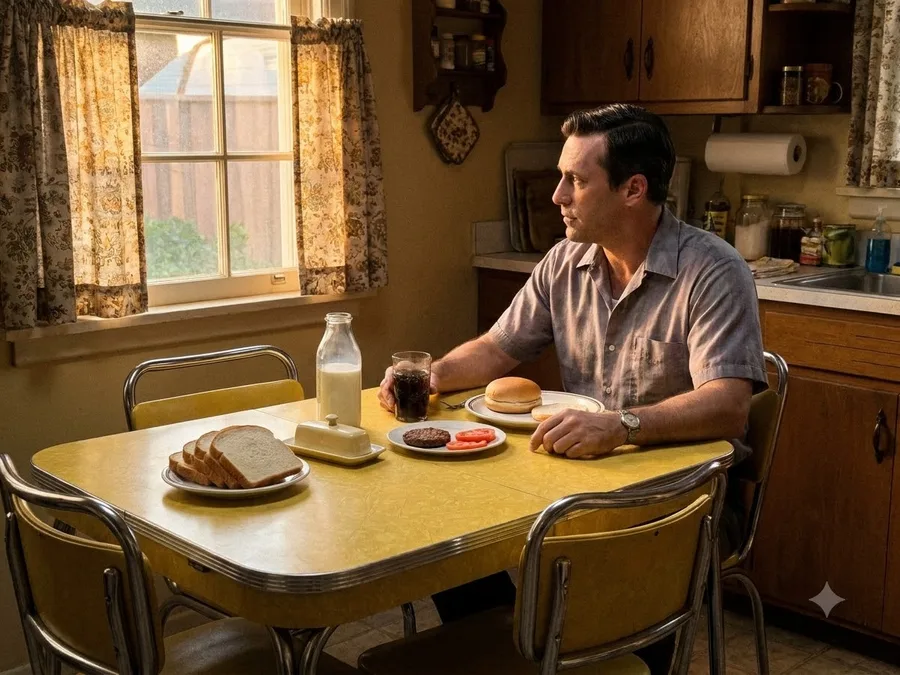
Their daily fare included sliced white sandwich bread, butter, beef and pork, full-fat milk, burgers, and Coke, yet they remained trim.
That’s the part that makes people stop scrolling. Because if the fattening stuff was on the table in 1975 and the country was thin, then something other than the menu was doing the work.
What they were not doing is just as telling. No one was counting calories. No one was counting macros, tracking points, or reading nutrition labels on the side of a box. Intermittent fasting wasn’t a plan – it was just the gap between lunch and dinner. Nobody in a 1970s kitchen was measuring anything except whether the roast was done.
This rules out the food itself as the whole answer. If the same hamburger and the same Coke produced different bodies in 1970 and 2020, the food alone can’t explain the difference.
The food was similar. The world around it was not – and that’s where the rest of this gets interesting. The same ingredients, served on smaller plates, at fixed times, with no pantry full of snacks and no kitchen open past eight, land very differently on a body.
Dinner Came From the Kitchen Every Night

A normal week looked like a rotation, and dinner came from the kitchen every single night.
Meatloaf on Monday. Pork chops on Wednesday. A chicken roasted whole on Sunday, turned into soup on Monday, and sandwiches on Tuesday. Not a scrap was thrown out, and everything stretched, so a single pound of beef fed more people than it would today.
Cooking that meal took an hour of someone’s time, and that effort did the portioning for you. The food that was made got eaten, the plate got finished, and the meal simply ended. Nobody hit a drive-through at midnight or ordered a second pizza, since the second pizza wasn’t there to order.
The kitchen closed after dinner. That invisible boundary kept a generation slim without anyone consciously trying, and it’s the first thing that disappears when cooking gets outsourced to an app. A delivery order has no natural end.
Understanding what happens in the first waking hour shows another daily window where your body decides whether to burn or store. There’s no pot to scrape, no leftovers to portion out for tomorrow, no reason to stop at one serving except the intention you brought to the table – and intention is a thin fence at 9 p.m.
The Cup and the Plate Got Bigger
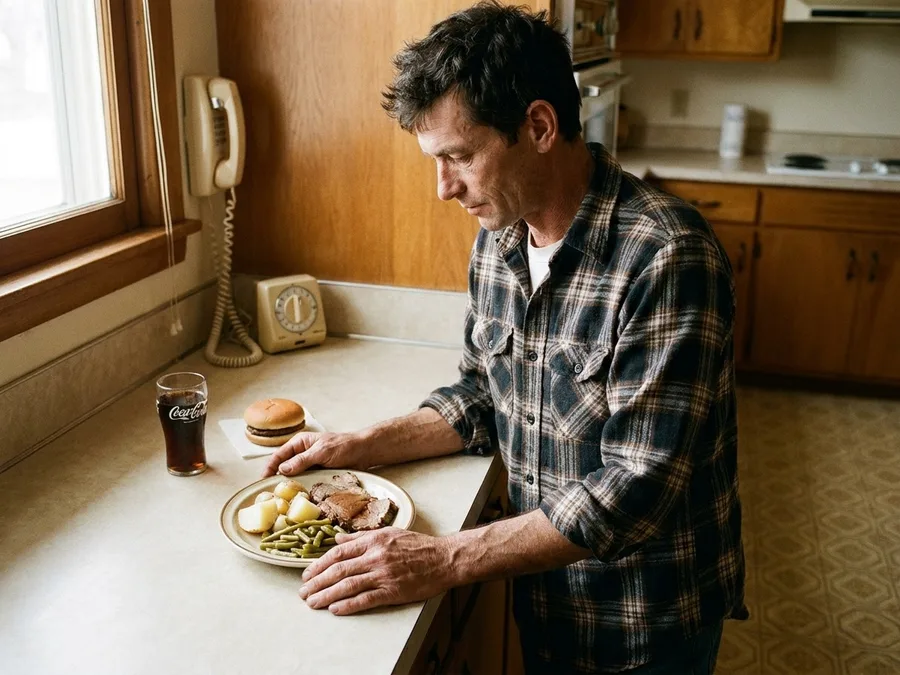
The portions got dramatically bigger, and the food itself barely changed.
Start with the drink. A regular Coca-Cola at McDonald’s in 1970 was 7 ounces. A medium today is 21, and a large is 30. Same syrup, same fizz – roughly four times the volume in a single cup, and the large is still treated as the normal order.
Then the patty. The original hamburger weighed 1.6 ounces. Today’s Quarter Pounder patty is 4 ounces before cooking, and it’s the one people apologise for ordering because it looks small next to what else is on the menu.
Now consider what you eat off. Dinner plates measured about 9 inches in the 1970s. These days they average 12, which works out to about 40% more of the same food, day after day, across 50 years, and nobody ever consciously chooses the extra.
The mechanism is almost unfair. Your brain is built to clear whatever sits before it, and it complies without fail. Discipline wasn’t what declined. What changed is the size of the servings, and the dish settles the matter before your intentions get a say.
One practical thing you can take from this: at your next dinner, serve onto the smaller plate in the cupboard and leave the rest in the kitchen. You’ll eat what’s in front of you, finish it, and feel done – because that’s exactly how the hardware works.
⚠️ COMMON MISTAKE
Don't blame the food, blame the size
Swapping to whole wheat bread while eating from a 12-inch plate misses the point. The plate, the cup, and the frequency did more than the ingredient list ever did.
Three Meals a Day, Nothing in Between
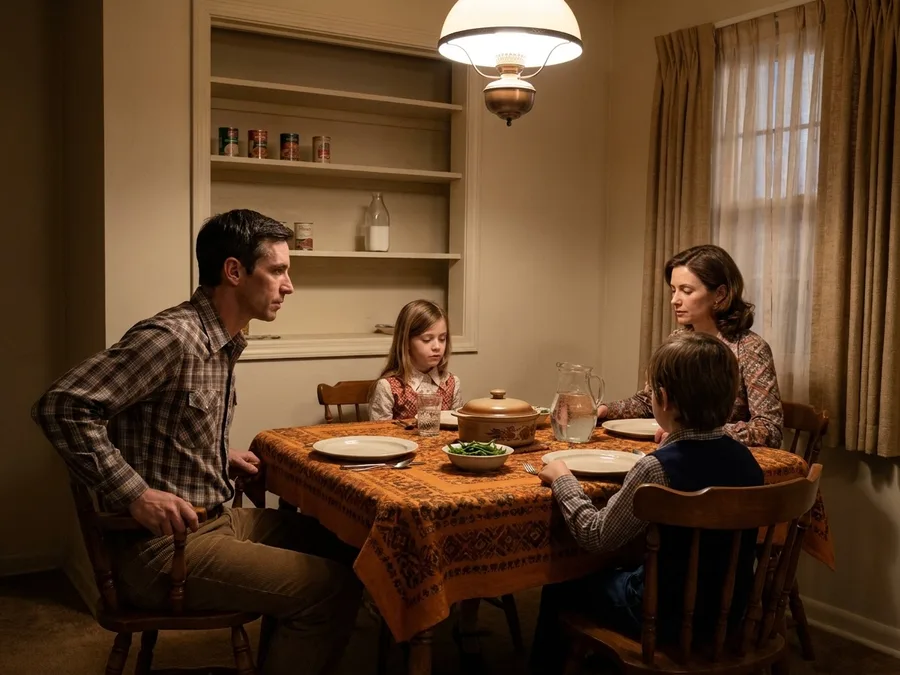
People really did go hours without eating anything at all.
Breakfast, lunch, dinner, and that was it. No mid-morning snack, no afternoon handful of chips, no protein bar at 4 p.m., no mindless grazing in front of the television at ten at night.
If you were hungry in between, the household rule was four words: wait until dinner. And it worked, not because the 1970s were full of iron-willed people, but because there was nothing in the pantry to break it with. The refrigerator had food for meals, not food for boredom.
These days, the typical American has a drink or a bite roughly every two and a half hours. Consider that for a second, because it isn’t hunger driving it, it’s routine. Very few people feel genuine hunger that frequently, yet the prompt to eat turns up on a timetable unrelated to your stomach.
The numbers that tell the story
Kids Played Outside Until the Streetlights Came On

The difference shows up in hours. A 1970s kid was out the door after school and didn’t come back until the streetlights flicked on, and all that time was movement nobody scheduled.
They rode bikes for miles, played pickup baseball in an empty lot, built forts, climbed trees, and came home filthy and exhausted. No parent drove them to practice. No coach set the drill. There was nothing to log on a watch because nobody was counting.
And none of it was done for fitness. Moving was just what children did, so the calories went without a gym membership, a team fee or a fitness tracker in sight.
The walk to school counted too. Most 1970s children walked or biked there; today fewer than 1 in 10 do. That’s two commutes a day, five days a week, quietly gone.
If you’re a parent now, you can’t rebuild 1975, and you shouldn’t try. Steal the two pieces that still fit your street: an unsupervised outdoor hour after school, and the walk to school when the distance allows.
Neither needs equipment nor a coach. One needs a front door you’re willing to open, and the other needs a route you’ve walked together first.
It isn’t that kids were stronger or more determined. The day simply had a shape that put them outdoors, and modern schedules don’t. Give that hour back and the rest follows.
The Fridge Held Ingredients, Not Snacks

It held ingredients. In a 1970s fridge you would find full-fat milk, eggs, butter, a slab of cheese, last night’s food in a covered dish, and at most a single bottle of Coke shared by the family on the weekend.
What you would not see is just as telling: no individually packaged snack packs, no six flavours of yogurt, no drawer of energy drinks, no freezer loaded with ready meals for every night of the week.
That difference is the whole story. Food was an ingredient, not entertainment. A kitchen stocked for cooking makes grazing inconvenient because there’s nothing to grab, while a kitchen stocked for grazing quietly makes cooking optional.
That one shift between a kitchen built for meals and a kitchen built for constant snacking explains more about American weight gain than almost any ingredient list you could read.
So try the audit tonight. Stand in front of your own fridge and go item by item, asking a single question: is this something I’d cook with, or something I’d graze on? Be honest, because a flavoured yogurt in a single-serve pot answers for itself.
The 1970s fridge vs. today's
1970s fridge
- One bottle for the whole family, weekend only
- Shop the perimeter; few center-aisle items
- Nothing edible without a dish or pan
- Closed after dinner; no evening return
Today's fridge
- Single-serve pots answer 'cook or graze?' instantly
- Center-aisle snacks outnumber ingredients
- Edible straight from the shelf, no dish
- Eaten or drunk every 2.5 hours on average
Sugar Was a Treat, Not a Daily Habit

It changed by a factor of nearly four. Added sugar ran about 40 pounds per person per year in 1970. Today it’s about 152 pounds, and that’s the whole distance between a treat and a habit.
Think about what soda meant then. It was an occasion: a birthday party, a ball game, a summer cookout. Not every meal, not a giant cup with free refills, not in your lunchbox every single day.
Then came high fructose corn syrup. It barely existed before it spread into the food supply in the early 1980s, and within a decade the obesity rate climbed steeply. The timing hints at a link rather than proving one, and it pays to keep that distinction in mind.
Which is why hunting one villain misses the point. The total and the frequency of added sugar is what actually changed, not the arrival of a single sweetener.
The next action is small and boring: read the label, and read it for every sugar listed, not just the one with the bad reputation. Cane sugar, honey, syrup, concentrate, they all count toward the number.
Pick one item you buy every week and check its sugar line. That’s a ten-second habit, and it tells you more about your own intake than any headline about corn syrup ever will.
The sugar was never the problem on its own. The frequency was.
Adults Moved All Day Without Calling It Exercise

Adults in the 1970s moved all day long without ever calling it exercise. In 1975 the typical American’s daily walking came to roughly 50% more than ours, and ordinary life, not workouts, produced that difference. Fewer cars and closer-packed neighbourhoods meant errands got done on foot, so the body kept busy without anyone noticing.
Think about what a Saturday looked like. A dad pushed a mower across the lawn, front to back, no motor, no self-propel, just effort and a bag of clippings. A mom walked to the store and carried the groceries home in her arms because there was only one car, and it was at work. Nobody logged a single minute of it.
Then look at the garage. No riding lawnmower. No leaf blower. No robotic vacuum is circling the living room at two in the afternoon. Every job that now happens with a motor or a button used to happen with a back and a pair of hands, and the calories went out the door with the effort.
Work itself did the same thing. Plenty of adults spent eight hours standing on assembly lines or hauling on loading docks, then came home and got down on their knees with a bucket and a mop to scrub the kitchen floor. That is a whole shift of movement before anyone even thinks about the yard.
The gym never replaced any of this, because movement was already everywhere. Adding an hour of exercise cannot outweigh a day of sitting, and no fitness tracker has ever changed that arithmetic. The same arithmetic changes after a certain age, when rebuilding your metabolism needs different habits than it did at thirty.
So when you hear that people were slimmer back then, remember they weren’t grinding through workouts. They were just doing slightly harder versions of everything, all day, without keeping score. The friction was the fitness.
🚶 From everyday movement to scheduled exercise
Push mower
A push mower burns roughly 250-300 calories an hour; a riding mower burns closer to 80.
Walk to the store
A 20-minute round trip on foot adds about 2,000 steps, which is nearly a fifth of a 10,000-step day.
Stand at work
Standing rather than sitting burns an extra 50 calories an hour, so an eight-hour shift adds roughly 400.
Hand-clean the floors
Scrubbing on hands and knees for 30 minutes burns about 150 calories, more than a robot vacuum ever will.
No leaf blower
Raking leaves for half an hour burns around 150 calories; a blower does the same job for about 40.
Fast Food Was a Treat, Not a Tuesday
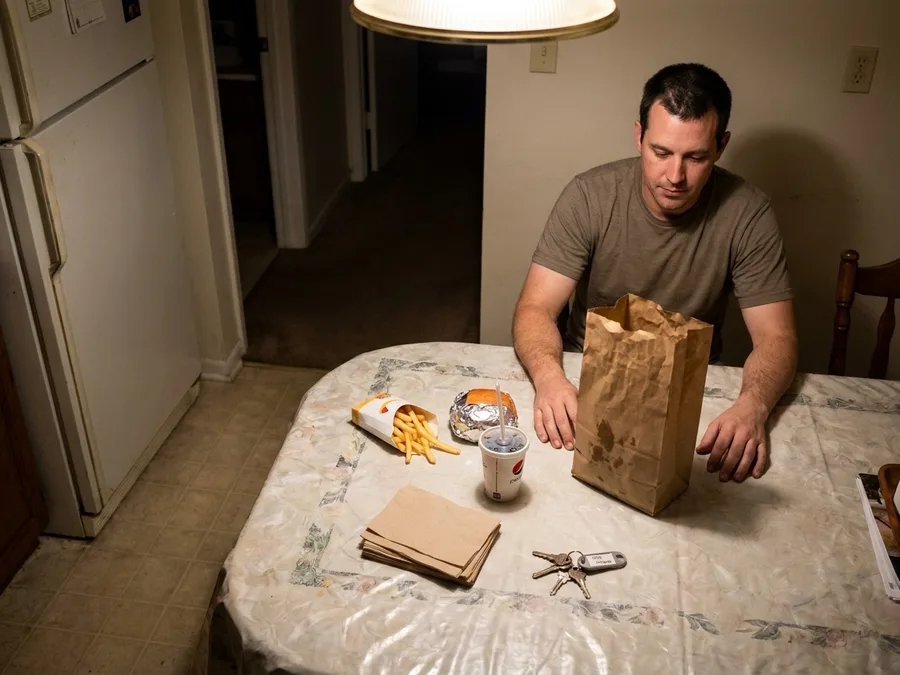
Because it was rare. McDonald’s, Burger King, KFC, and Dairy Queen were all there in the 1970s, so the chains aren’t the explanation. The frequency is.
Fast food used to be an occasion: a special Friday-night outing, a birthday celebration, perhaps once or twice a month at most. What you ordered suited the occasion. A hamburger, some fries and a small Coke, and that was that.
No super-sizing existed. No value meals were engineered to make you eat more than you intended. The menu wasn’t quietly pushing a bigger version on you at the counter, because the bigger version hadn’t been invented yet.
Everything shifted once fast food crossed over from special occasion to everyday routine. The Tuesday-evening stop on the drive home because nobody wanted to cook. That’s a different food entirely, even when it’s the same burger.
So run a quick count. If you get takeaway twice a week rather than twice a year, that’s the habit to look at, and it deserves more attention than any single ingredient on the menu.
Keep the treat. Just notice how often the treat turned into the plan.
💡 PRO TIP
The treat rule that still works
Keep the treat but make it rare and small. One hamburger, some fries, a small Coke, once or twice a month. That's not deprivation, it's the frequency that changed.
Everything Changed at Once in the 1980s
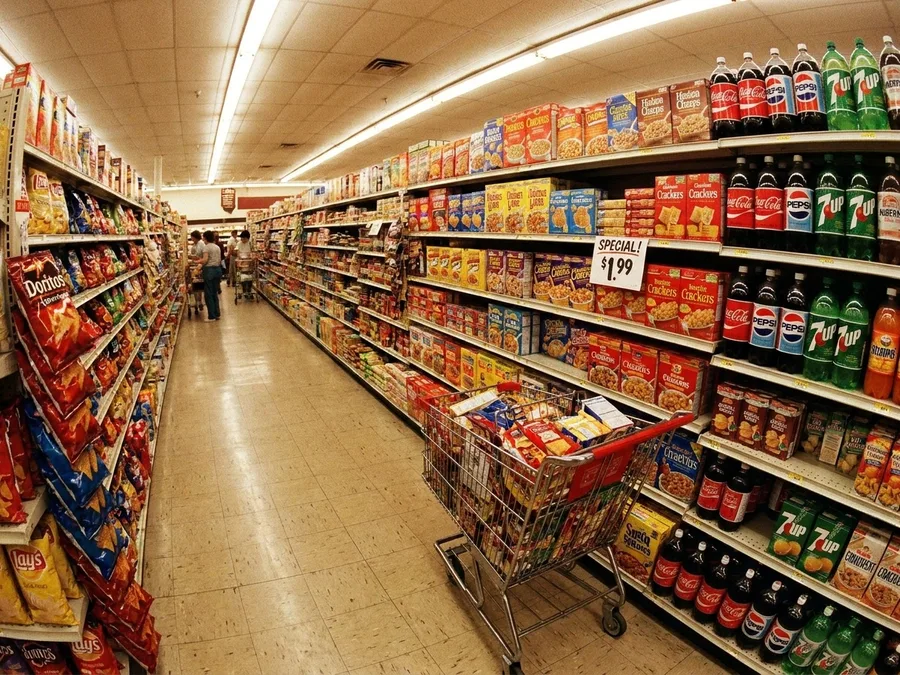
Almost nothing on the list looked like a turning point while it was happening.
High fructose corn syrup slipped into the food supply, which made sweet things cheaper to make and cheaper to buy. Both parents went to work. Restaurant portions crept up. Televisions ran longer, kids stayed indoors more, and snack companies figured out that a box of small bags sold more crackers than one big bag ever would.
Drive-through windows multiplied. Frozen dinners got good enough that nobody felt sorry for you. Delivery stopped being a phone call and a wait.
Every one of those changes was small enough to shrug at. A bigger soda here, a bag of chips there, a school playground that emptied a little earlier. Nobody sat down and decided the country would get heavier.
That is why it took a while to show. Change lands gradually, and the yearly photo does not move. Ten years in, a crowd starts to look a little different. Twenty years in, you dig out a picture from 1978 and the people look like they belong to another planet. The numbers follow the same curve: about 13% of adults were obese in 1970, roughly 42% today.
This is exactly why no single cause holds up. Nobody can point to one ingredient, one law or one company and say that was it, because the shift was a dozen things piling on top of each other. And no single fix will unwind it for the same reason.
So watch what is being normalised around you right now. The default that gets quietly rebuilt this decade, and nobody argues about, will be the one worth noticing.
We did not lose our willpower. We lost the world that made willpower unnecessary.
— What the 1970s comparison keeps repeating
Nobody Was More Disciplined — the World Was Different
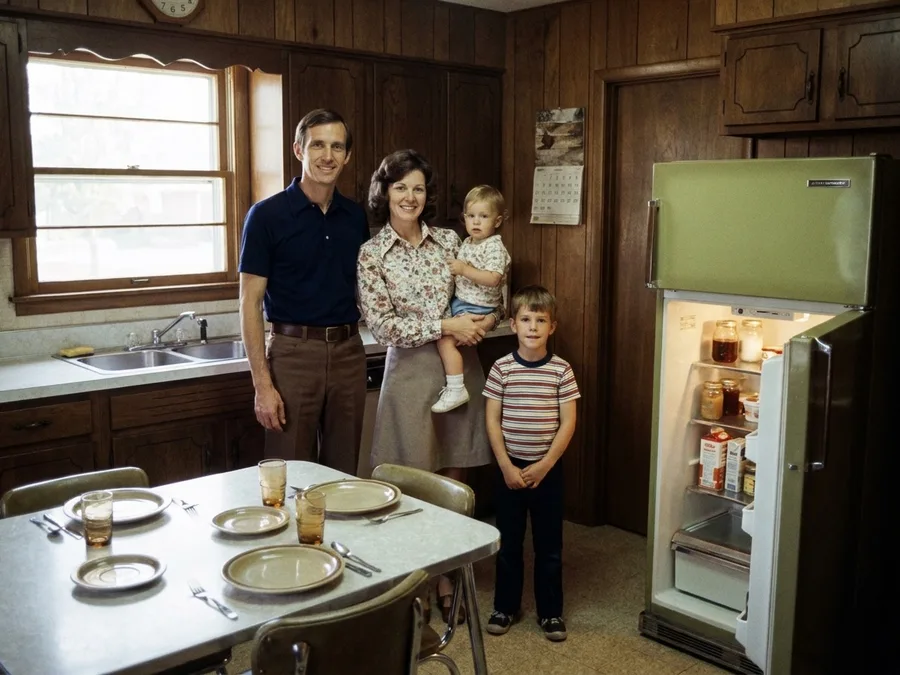
Nobody in those photographs was more disciplined than you. Look closely at what they weren’t doing: no calorie counting, no step tracking, no label reading, no wellness influencers, no meal-kit subscriptions arriving in a box on a Tuesday.
They weren’t stronger. They were living somewhere that staying slim was the path of least resistance. The small plate was already on the shelf. The kitchen was already closing after dinner. The snack was already a rare thing because there were none in the fridge. That’s not willpower. That’s a default.
Willpower wasn’t what we lost. What disappeared was the environment in which willpower was never needed, and we still expect the old discipline to hold up against these new conditions.
Now, the honest limit. The environment explains a population shift, not every individual. Medication, illness, genetics, and money still decide individual outcomes, and if you’ve done everything right and still gained weight, that isn’t a failure of this idea. It means your body has its own story running alongside the country’s.
So don’t do nostalgia with it. Nostalgia is a feeling and it changes nothing. Change the default, not the resolve. Put the smaller plate on the shelf and the snacks out of the house, and let the surroundings do the work your willpower was never meant to do alone.
Rebuild the Defaults Without Giving Up Modern Life

You can borrow the 1970s defaults without moving to a farmhouse. The cheapest ones are almost embarrassingly small: a 9-inch plate, a kitchen that closes after dinner, a pantry with no individually wrapped snacks, one set cooking night a week, one walk that replaces one short drive, and, where the street allows it, an unsupervised outdoor hour for the kids.
Take just two and combine them. Picture a 9-inch plate and a 7 p.m. kitchen close on the same day. Dinner gets plated once, nothing is sitting out for seconds, the kitchen goes dark, and the whole evening grazing window evaporates without a single act of willpower. Your shopping list stays boring and ordinary: milk, eggs, butter, cheese, meat, vegetables, bread, and one bottle of something fizzy for the weekend.
Keep the modern tools that don’t break the logic. Grocery delivery, a freezer, a slow cooker, a dishwasher. None of those change the portion, the frequency, or the closed kitchen. They only make cooking at home easier, and home cooking was the whole point.
If you live in a flat, work shifts, or have no safe street for the kids, you can’t copy all of it. Closest substitutes: a set dinner time you can actually keep, a lunch you pack the night before, a walk to the bus stop instead of the car, and a screen-time swap rather than a free-range afternoon. The defaults adapt. The principle doesn’t.
Your Body Isn’t a 1970s Average

Two people can eat the same dinner and end up with very different bodies, and both of those things can be true at once.
The population-level story explains why a country drifted, not what your particular body will do with a plate of food. Genetics, hormones, medications, sleep, stress and medical conditions all pull on the same scale. Averages describe millions of people. You are one of them.
The environment has kept moving too, which people forget. Standing jobs got replaced by desks. The television that ate the 1970s evening turned into a phone in your hand and a laptop on your lap, so even the small movements that used to happen by accident have been designed out of the day.
If the environment were the whole answer, everyone in the same town would weigh the same. They don’t. That is where thyroid problems, appetite-driving medications, PCOS, and a history of disordered eating come in, and none of those get fixed by eating like it’s 1975.
So take the parts that apply to you, the smaller cup, the kitchen that closes after dinner, the walking you stopped doing, and leave the rest alone. If something doesn’t add up, talk to a clinician instead of a vintage cookbook with a nice cover.
What the 1970s Can and Can’t Give You
The verdict: the 1970s were an environment, not a moral achievement, and it can’t be reassembled whole. What you can restore this month are the defaults: a 9-inch plate, a kitchen that closes after dinner, a pantry without snack packs, and a treat that stays rare.
The plate and the kitchen close pay off fastest. They work without willpower because they change what’s in front of you before the decision is made.
If you’ve blamed your willpower for years, stop. The default was doing most of the work back then, and the default is doing most of the work now — against you. But if your problem isn’t food at all — a thyroid condition, a medication that drives appetite, money stress, a shift schedule that makes cooking impossible — a 1970s kitchen won’t fix it. Take that part to a clinician, and take the defaults you can actually keep.
Pick one default tonight
Go to your kitchen, find the dinner plate, and measure it. If it's 12 inches, swap it for a 9-inch plate and set a close time. That's the whole experiment.
