
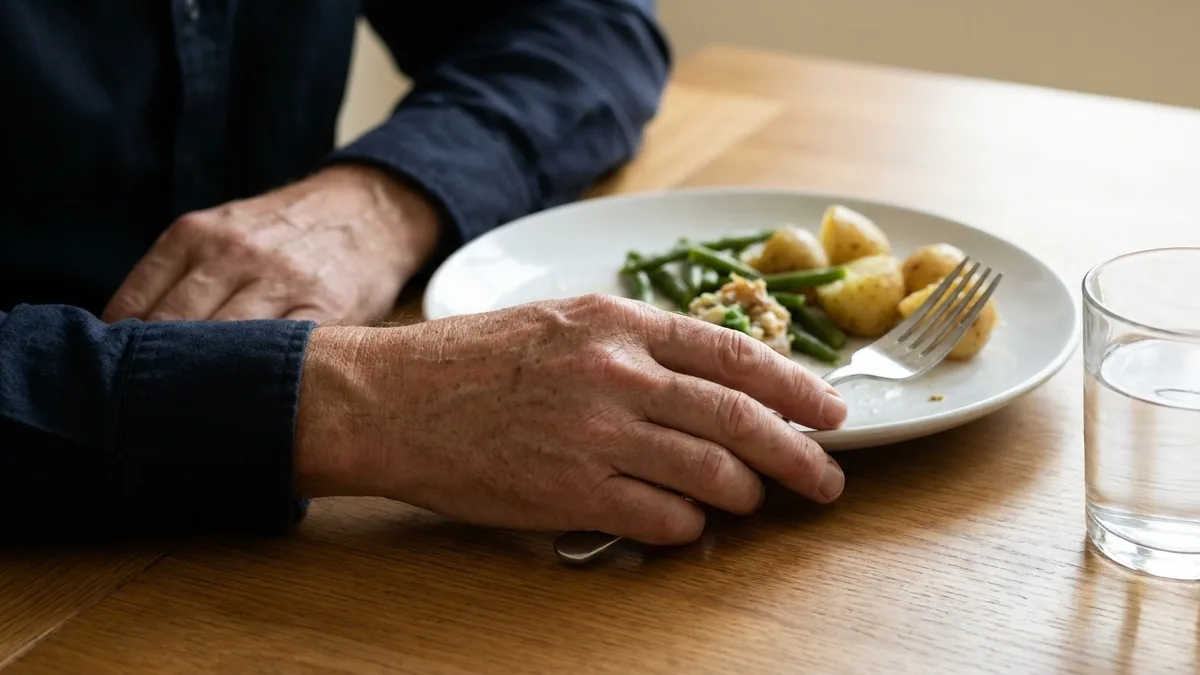
The hunger you were supposed to notice arrives after the last bite, not during it. That gap, not the speed itself, is what decides how much you eat.
You finish the plate, the fork keeps moving, and only then does the question land: was I still hungry at any point in there? You had no moment to answer it.
Most people come to this expecting another diet, a smaller plate, a calorie app, a rule about chewing. The piece that is actually missing is a pause, a spot in the meal where fullness could register and a choice could be made.
So bring three small physical cues to the next meal you control: put the fork down every few bites, keep water within reach, and stop at the halfway mark to ask whether you are still hungry.
Slower eating does not shrink the meal by itself. It builds in small stopping points, and what you decide at those points is what makes eating less feel like a choice rather than a restriction. For some readers, eating less should not be the goal at all, and the last section says who.
⚠️ COMMON MISTAKE
The pause is not a diet rule
Treating the pause as a rigid rule — no seconds ever, plate must be empty or must not be empty — makes it a test you can fail. The pause only creates a chance to decide. Missing a pause is not a moral failure, and a fast meal is not one either.
Why would eating more slowly make me eat less?
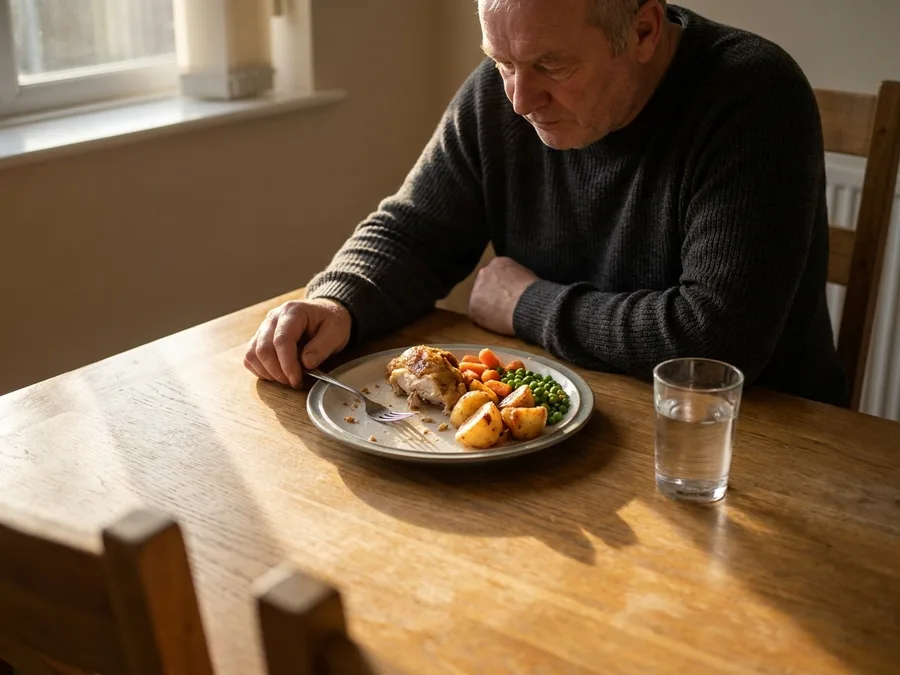
The slowing down is not what cuts the meal. The pause is what cuts the meal, and a slower pace is simply what makes pauses possible. Every extra minute at the table buys another small stopping point, and each stopping point is a chance for fullness to surface while there is still food in front of you.
Fast eating does not skip hunger. It skips the moment when hunger could have been checked, and the sequence runs on without interruption. A second helping arrives because the hand was already reaching, someone else's leftovers get finished because the plate was in reach, and comfortable fullness turns into uncomfortable fullness without any point where you could have noticed the line.
A typical example makes it plain. The plate is empty and the second serving is already plated before the thought of whether you were hungry has even arrived. That is not a decision to keep going, made against your own interest. It is a decision that was never offered.
One caution, and it is honest: researchers describe fullness as a signal that builds over the course of a meal, but nothing in this method rests on a hormone name or a minimum number of minutes. The mechanism here is the pause and the choice it allows, and that is all it claims to be.
Portion size still shapes the math. A larger serving puts the halfway point further out, so any natural pause arrives later, and more food is still sitting in front of you when it does.
| Moment | Fast default | Slowed alternative | What it changes |
|---|---|---|---|
| First few bites | Forks keeps moving, food disappears quickly | Set fork down every few bites, take a sip of water | Creates a small break before the next bite |
| Midpoint of the plate | Halfway passes without noticing | Pause once half the plate is gone and check hunger | A fixed marker for a decision |
| Second helping | Taken as a reflex when the plate empties | Pause first, then decide whether to take it | Turns a reflex into a choice |
| End of meal | Plate clean before fullness is felt | Notice fullness at the pause; leaving food is allowed | Fullness gets a chance to register before the plate is empty |
What do I actually do at the table?

Three interruptions do the work, and each one is a physical action rather than a mental rule. Pick up the fork, set it down, reach for the water, pause when the plate is half gone.
The fork goes down every few bites, not every bite. Every-bite rules turn a meal into a task, and tasks get abandoned around the third dinner. Every few bites is loose enough to survive a normal week, which is the only test that matters.
The water sits within reach and gets used on purpose. Reaching for the glass is the break; drinking is incidental. You are not chasing a hydration target, you are giving your hand a different place to go than the plate.
At the halfway mark, stop and check your hunger before you keep going. And the halfway point is the point, because it is visible, sitting there in plain sight. You do not have to detect a feeling, or guess at one, or argue yourself into noticing anything. You look at the plate, see the empty half, and it prompts the check for you. That also tells you why this is easier late in the meal than at the start.
All of it fits inside a work lunch. No app, no timer, no special food, nothing a colleague would glance at twice. Water in a mug, fork down between bites, and a glance at a half-empty plate is a normal lunch to everyone but you.
💡 PRO TIP
The half-plate marker works better than a clock
Watching the clock turns the meal into a test. The midpoint of the plate is a fixed, visible cue that requires no timer, no app, and no attention to minutes. When half is gone, you have a built-in reason to pause.
Will eating slower really mean I eat less?
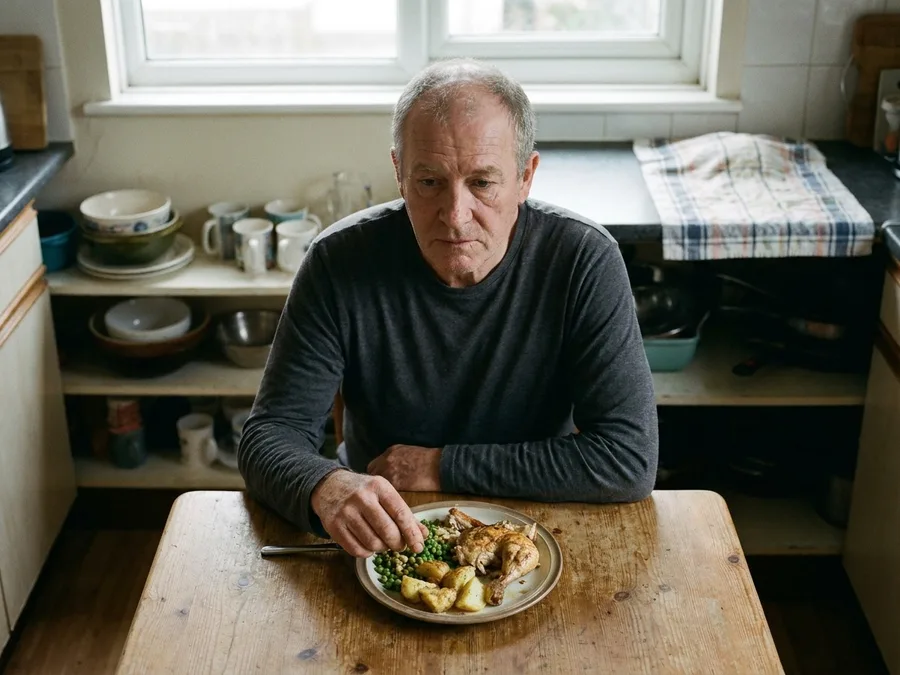
Slower eating works only when the pause inside it gets used for something. The cues from the previous section buy you an opening, roughly ten or fifteen seconds at the midpoint of the plate, and nothing about them shrinks what you eat unless you do something with that opening.
At each one, three options are on the table. Carry on exactly as planned, serve yourself a smaller second helping, or finish where you are. That is the whole menu, and choosing none of them is still choosing.
This is where slow eating quietly fails. Portion the same food across twice the minutes and the plate ends up just as empty, only later.
The mistake people make is treating the slowed pace as the result rather than the setup. If every pause ends in the same fork-lift-and-continue, the meal stretches and the intake does not move. The pause is the chance to decide; it never decides for you.
Leaving food behind is allowed. A half-finished plate is one legitimate outcome of the check, not evidence of waste and not a failure of the exercise. Some meals you will stop early, most you will not, and the practice holds either way.
What changes across a week of this is not the speed. It is that each meal now contains a few moments where continuing became a choice rather than a default, and some of those choices will go the other way.
What the pause is actually for
Using the pause
- Three to four pauses per meal, timed to the halfway point
- Ten to fifteen seconds is enough to decide
- Pick one of the three options out loud, even silently
- Stop at comfortable fullness, not clean plate
Just eating slowly
- Pause count under three, or none at all
- Pause length under five seconds
- Plate emptied on autopilot
- Speed dropped but portion unchanged
Why does slowing down fall apart in real life?
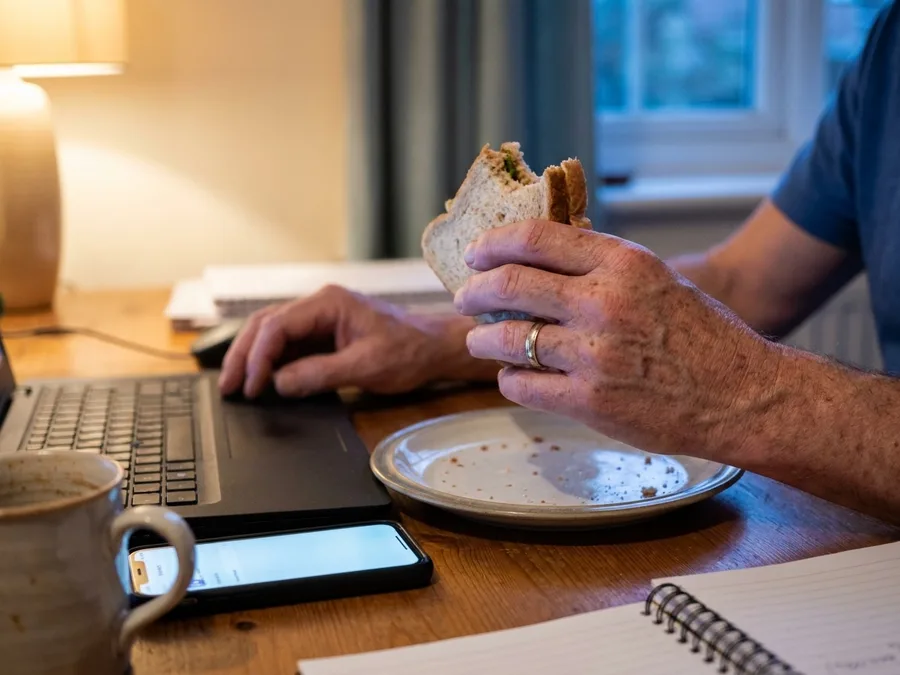
Most of the time the pause never gets taken, and it is the room and the company that take it from you, not your character.
The phone is the biggest pace-setter. When the screen supplies the rhythm, the hand keeps moving without anyone noticing a stopping point pass by, and a desk lunch with a phone open is a meal eaten entirely on someone else's tempo.
Fast company does the same thing. A coworker or a family member finishes before you are halfway through, and you match their speed to stay in step at the table rather than sit there with a fork hovering over a plate while everyone else has pushed back.
There is a workaround, and it is small. Put the phone in another room for the meal, or set aside one designated meal a day as your practice, so the pace is decided before the meal starts rather than negotiated in the middle of it with a screen already lit.
This is an environment and company problem. The reader who tries a desk lunch with the phone open and keeps eating at screen speed has not been shown to lack discipline.
🍽️ Build the pause in five small steps
Choose one meal
Pick a meal where you set the pace, like breakfast alone or a weeknight dinner.
Set the environment once
Phone in another room, water on the table, a smaller serving spoon.
Fork down
Set the fork down every few bites, not every bite.
Sip and check
At the halfway point of the plate, pause and ask if you are still hungry.
Decide
Continue, take a smaller second helping, or stop — the pause only counts if you act on it.
Where should I start?
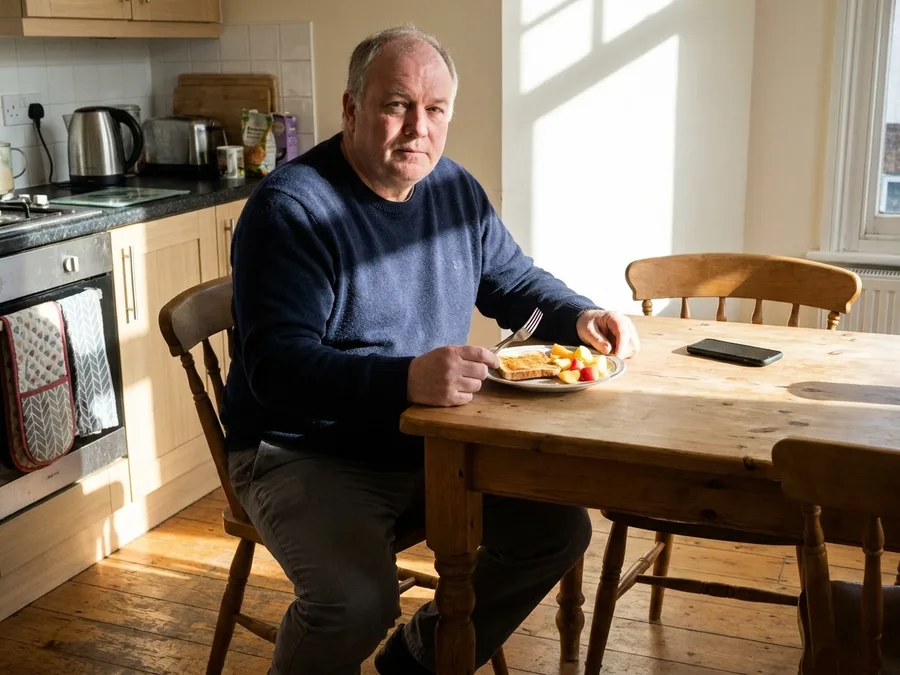
Start with a single meal whose pace is yours to set. Not the family dinner where three people talk over each other, not the office kitchen where someone always walks in mid-bite. Breakfast before anyone else is up, the desk lunch you eat alone, a Tuesday supper you cook and plate yourself. Any one of those works, because nobody there decides your speed but you.
Set the table once. Phone face-down in another room where you cannot answer it, a glass of water poured and sitting within arm's reach, and a smaller serving spoon in the dish rather than the big one that fills half the plate in a single scoop. That last part costs nothing and quietly shrinks where the plate starts, which means the halfway marker arrives sooner and with more food still sitting in front of you.
Then practise on that one meal for a week before you add a second. Six scrambled attempts across every meal collapse by Thursday; one that holds for seven days is worth more than all of them. A week is enough to know whether the fork-down habit fits how you actually eat, and short enough that a bad day does not talk you out of it.
The target that week is noticing fullness, not the clock. No timer on the table, no counting chews, no rule about how many minutes a meal should last. Put a fork down when you think of it, take a sip, stop at the halfway point and ask whether you want the rest. Watching minutes turns lunch into a task you will quit by Friday.
Quick Tips Before You Start
Put it down mid-chew
Setting the fork down while still chewing, not between bites, is what actually adds the seconds.
Sip after the swallow
Drink once the mouth is empty; sipping to wash down a bite just speeds the next one along.
Track the plate, not time
Half the food gone is the signal to pause. Hunger can return mid-plate and still be real.
Silence it before you sit
A buzzing phone pulls you back even face-down, so switch it off, not just over.
Serve, then step away
Plate from the stove and leave the dish there; the second helping then takes a deliberate walk.
Same meal, same chair
Repeat the identical meal for the week, so a change in fullness points to pace, not the menu.
Who should not try to eat less this way?

Some readers should not use a slower pace to eat less, and they need to hear that before they try it.
If you have an eating disorder, a history of one, unintended weight loss, or you are pregnant, or your nutrition is shaped by a medical condition, talk to a clinician before you make eating less a goal at all.
This is built for ordinary eaters who want to stop at comfortable fullness. It is not a treatment plan and not a substitute for individual medical advice.
If you have a personal calorie or weight goal, take it to a registered dietitian or your doctor rather than to a general article. They can see your history and adjust for it; I cannot.
And keep the tone steady. Speed is not a character flaw, and a fast meal is not a moral failure. If slowing down is not right for you, the plate is still allowed to be cleared in ten minutes.
Frequently Asked Questions
How many times should I set my fork down during a meal?
Every few bites is enough. Setting it down after every single bite turns the meal into a task and becomes too fiddly to keep up. The exact number matters less than having a few deliberate interruptions between start and finish.
Do I need a timer or an app to eat more slowly?
No. The halfway point of the plate is a fixed, visible cue that needs no clock and no phone. Adding a timer often makes the meal feel like a test, which is the opposite of what a pause is for.
What if I finish my plate before I notice I am full?
That happens, especially at first. The pause is a practice, not a pass-fail test. Next meal, put the fork down a few bites earlier and check hunger once half the plate is gone, before the end arrives.
Can I still eat with family or coworkers who eat quickly?
Yes, though it is harder. Their pace can pull yours along. Try one meal a day on your own first to build the habit, then bring the cues to shared meals where you can.
Is leaving food on the plate wasteful?
Leaving food is a permitted outcome of the pause, not a failure. If wasting food bothers you, serve a smaller portion to begin with so the amount on the plate matches what you are likely to eat.
Does eating slowly help with weight loss?
It can help you eat less when you act on the pauses it creates, but it is not a weight-loss guarantee. Slower eating with the same intake and the same end point leaves you in the same place. For personal weight goals, talk to a registered dietitian or doctor.
The next meal you control is the whole experiment
The slowing down on its own is worth nothing. The eating less comes entirely from the decisions taken at those pauses, and those decisions are the practice – everything else is just the setup that makes them possible.
The verdict, plainly: a meal eaten fast has no stopping point, and a meal eaten with pauses has several. What you do at them is yours to decide, and some days you will decide to keep going. That is not failure. That is the choice working.
Go back to that first plate. The fork set down at the halfway mark, the water within reach, the question asked while food is still in front of you rather than after it is gone. That is the whole difference – the moment arrives earlier, and you are there for it.
So at the next meal you control, put the phone in another room before you sit. Set the fork down after every few bites. Pause halfway and ask whether you are still hungry, then decide whether to continue. No calorie target, no weight-loss promise – just one meal, one pause, one decision you get to make.
Try one paused meal this week
Pick a meal where you set the pace, set the cues once, and see what the pause shows you. That is the only experiment you need to run.
