

Skip the medication check and the protein plan, and the first thing a shorter eating window takes from you may be strength in your legs and a full night’s sleep, not weight off your waist.
You have heard a coworker, a podcast host or your own grown child praise 16:8, and you are curious. You are also carrying some extra weight and a knee that complains on stairs, and at 54, there is less room to improvise than there was at 35.
So treat this as a trade, not a trick. The trade is this: you shorten the eating window, and in exchange, you protect your lean muscle, your bone density, your sleep and the timing of your prescriptions. Do the first two badly and the third and fourth bill you later.
That makes it a protected experiment, priced honestly. Run 14:10 before 16:8, keep protein and two lifting days in the budget, and measure four things for four weeks before you decide anything.
| Point | 16:8 daily | 5:2 weekly |
|---|---|---|
| The pattern | Fast 8 p.m. to 12 p.m. daily; eat between noon and 8 p.m. | Two non-consecutive low days (Monday and Thursday) at roughly 500–600 calories; five ordinary days |
| Meals inside | Two meals plus an afternoon snack, no calorie counting | Normal eating on five days; low-day calories set with a clinician |
| Best for | A fixed workday and an early dinner | Frequent restaurant dinners and travel |
| Skip if | Late dinners or breakfast meetings cannot move | Low days would land on strength days or trigger binge urges |
| In the 54-year-old example | Chosen as the target, but she starts at 14:10 first | Not chosen — Monday/Thursday low days would sit near her twice-weekly lifts |
| Monthly cost | $0 for the schedule; $45 gym; about $70 extra on protein and groceries | Same base costs; low-day food may lower the grocery total slightly |
Muscle, bone and sleep are what’s at stake
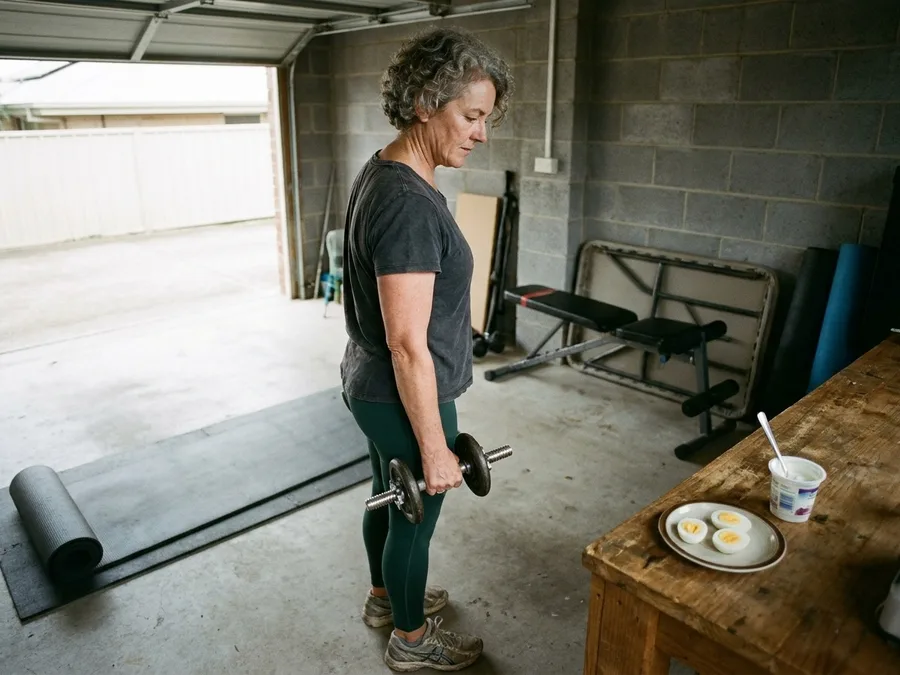
Three things deserve protection before you count a single skipped meal: your lean muscle, your bone density and your sleep. A shorter eating window does not create a calorie deficit so much as compress the hours you have to load protein and the chances to lift.
After 50, when the body builds muscle from protein less efficiently and bone responds only to load it actually feels, fewer meals and a lift stranded hours from real food are the costs people miss. Weight dropping on low protein and light loa low-protein come off partly from muscle and bone, not just fat.
Put the protein at your first meal inside the window, not banked for dinner. The first meal does the most work because it lands when the fast breaks and the muscle signal is waiting, so a midday plate with eggs and yogurt beats a big dinner eaten against a fourteen-hour gap. Lift two or three times a week in the example, and place the session after the window opens so the meal that follows is a real one, not the start of another fast.
Judge the schedule by what it protects. A plan that costs you sleep, your lifts or your protein is the wrong plan before it gets to be a weight-loss plan.
Perimenopause moves hunger and sleep around

The three things you are trying to protect do not sit still from one month to the next. Hot flashes that wake you at 2 a.m., appetite that swings wide in the same week, and night sweats that come and go without warning all move the same eating window around. The plan you set in March can feel wrong by June in an unchanged body, and that is a signal to adjust the dial, not to tear it out.
Two early warnings tell you the window is mis-set for this month: waking at 3 a.m. and a hollow, shaky hunger that lands around 4 p.m. Those are the markers to watch for.
An 8 p.m. last meal can settle sleep by ending late eating, or shatter it by stacking hunger and stress on top of an already broken night. You will not know which one you are getting if you change the cutoff and the first meal in the same week.
Take the example’s 12 p.m. to 8 p.m. window. During a run of poor sleep, the move is to widen back to 14:10 for a week or two, keep the protein and the twice-weekly lifts exactly where they are, and watch whether the 3 a.m. waking eases. Quitting the whole thing because one variable went sideways is the wrong read on a bad month.
For men in the same decade, the hot-flash piece does not apply, but the sleep and strength signals still lead. Same rule, same dial.
Some prescriptions decide the schedule for you

Your prescriptions get the final word on whether fasting is even on the table, and the timing question is more specific than most people assume. Three drug types decide it first. Blood-sugar medication asks whether the dose needs food beneath it and what a skipped meal does to the numbers.
Blood-pressure pills ask whether time of day matters and whether the dose needs revisiting once the window changes. Thyroid tablets ask whether the empty-stomach rule can be met once the first meal moves later.
Before the first skipped meal, take a full list of your medications and supplements to the prescriber and name the meals you plan to skip, plainly. A baseline blood panel and a home blood-pressure log come first, and the clinician sets what gets rechecked and when.
If the answer comes back not with this medication, that settles it. The schedule is not negotiable against a prescription, and no tweak to the window makes it so.
The month-to-month adjustments are real, but they stop at a drug that needs its food.
⚠️ COMMON MISTAKE
Don't start before the list
The most common mistake after 50 is moving the first meal before showing a prescriber the full medication and supplement list. Book the visit, bring the list, and let the clinician set what gets rechecked. Starting first and asking later is how a manageable schedule becomes a medical question.
16:8 fits a workday; 5:2 fits a social calendar

The two schedules fail in different places, so pick by the week you actually live rather than the one you wish you had. A 16:8 day ends the kitchen at 8 p.m. and keeps it shut until noon the next day. What sits inside those eight hours is two proper meals and a mid-afternoon snack, and no one is counting calories.
It rewards a desk job and an early dinner, and it punishes both ends of the day: the 7:30 dinner with friends becomes a scramble, and the 8 a.m. breakfast meeting is a glass of water while everyone else eats. If either of those repeats most weeks, 16:8 is the wrong tool before it is a hard one.
The 5:2 version spreads the same difficulty thinner. Monday and Thursday become low days of roughly 500 to 600 calories, and the other five are ordinary; a clinician sets that low-day number rather than a podcast. It survives restaurant dinners and travel because those land on ordinary days, and it concentrates the discomfort into two blocks you can see coming.
The 54-year-old in the example went the other way. Desk job, dinner at 6:30, two lifts a week at a $45 gym: the daily window fit her calendar, and Monday-Thursday low days would have landed on her training days. She still starts at 14:10 before calling 16:8 her target. The schedule that survives two months beats the one that looks disciplined for two weeks.
Which schedule survives your week?
16:8 daily
- Pick it if your dinner is home by 6:30
- Fails first on the 7:30 reservation, not the fasting
- Your lift is fine; move it inside noon to 8 p.m.
- Warning sign: two skipped breakfast meetings a week
5:2 weekly
- Pick it if two dinners out land most weeks
- Keep low days at least three days apart, never back-to-back
- Park low days 24 hours from any lifting day
- Fails first on the five ordinary days, not the two low ones
A 14:10 window is the version to try first

Start with ten hours of eating and fourteen of fasting, because that margin leaves room to fix a problem instead of abandoning a plan.
In practice it is unglamorous: the last bite by 8 p.m., the first one at 10 a.m. the next morning. Nothing is counted, no food is banned, and the two extra waking hours of fasting buy you a test period where the medication timing and the sleep question get answered with real data instead of guesswork.
The ramp is where most people go wrong. Push the first meal back 30 minutes every three days until it lands at noon, so the shift from 10 a.m. to noon takes a bit over two weeks and passes through 10:30 and 11:00 on the way.
When a stretch stalls, do not force it. Hold that time for another three days, and if it still will not sit, back up 30 minutes, stay there a week, and try again. Fasting that has to be white-knuckled at 11 a.m. is telling you the window is wider than you want it to be right now.
Two effects are worth knowing before you start. Meals stay close to morning doses, so the blood-pressure and thyroid questions raised earlier stay simple. And a bad night, the kind that has you awake at 3 a.m. with your stomach growling, is fixed by opening the window 30 minutes, not by quitting the whole thing.
⏱️ Your first two weeks at 14:10
Bring the full list
Every prescription, over-the-counter pill and supplement, including doses and times, so the eating window is built around doses instead of the other way around.
Day 1, 8 p.m.
The first fast starts the night you decide, not the next morning. Nothing after 8 p.m. counts as a cheat, only as a later start.
Days 4, 7, 10
First meal at 10:30, 11:00, 11:30, then noon on day 13. Three days at each stop, not two.
What a stall looks like
Stalled means the same first-meal time for three days running. Back up 30 minutes, stay a week, try again; do not skip ahead to noon.
Weekend test
Keep the same window Saturday and Sunday. A later cutoff on either day restarts the two-week ramp from day 1.
Fasting costs nothing; the protein and gym do

The schedule costs nothing. What costs money is everything that makes it safe: the gym, the protein and the clinician visits.
Run the numbers for the 54-year-old example. Zero dollars for the eating window itself, $45 a month for the gym, and roughly $70 extra on protein and groceries once the meals are built around it. About $115 a month before clinician copays.
Add one baseline visit and one follow-up on her insurance plan. Check the copay on your own plan before you book, because that figure moves.
The money to stop spending is the fasting apps, the teas and the fasting support supplements. None of them do the work. The free parts, meal timing, walking and lifting, are what everything else leans on.
Get the protein and the gym in place first. Without them the free schedule is just a skipped breakfast.
Monthly cost of 16:8 — At a Glance
🕛 Protein math
~100-110 g a day, split across the two meals and the snack
🏋️ Lifting floor
Twice a week at $45; dropping to once a week is where muscle goes first
🥚 Where the $70 lands
Eggs, Greek yogurt, chicken, whey — the snack slot, not the dinner plate
🩺 Book these two
Baseline before day one with your full med list; follow-up at week 4-6 to recheck timing
📱 Cut line
Apps, teas, fasting salts — all $0 of the work; the 12 p.m. first meal is the whole tool
Failure mode
The month that breaks the budget is the one that pays for the fast ($0) and skips the protein and the gym — that is the version that costs muscle.
Move breakfast later before you move dinner earlier

Start by sliding the first meal, not the last one. The plate at 8 p.m. stays exactly where it is for now, and the thing that moves is breakfast: 10 a.m. today, 10:30 three days from now, then 11, until the first meal lands at noon.
Three days is the unit because that is roughly how long hunger hormones take to settle into a new pattern before you can judge whether a change actually works.
Between those meals, the list is short. Water, black coffee, plain tea. A splash of cream or a spoon of sugar ends the fast, so the coffee you have drunk for thirty years becomes black coffee or it becomes breakfast.
Expect day three to be ugly. The mid-afternoon stretch is where it hits, and the fix is a protein snack inside the window plus a ten-minute walk, not an earlier first meal. Move the meal earlier once and you have taught yourself that mild hunger is an emergency.
Only after the morning shift has held for a full week does the 8 p.m. cutoff come under review. Shift both ends at once and a bad night tells you nothing about which change caused it. One lever at a time is slower and it is the only version where the four-week measures mean anything.
Fill the window with protein, then lift

Protein goes in the first meal, not saved up for dinner. That noon lunch is where the muscle signal gets sent after fourteen hours without food, and eggs with yogurt is the plainest version of it. Push protein to an evening steak and the window’s longest gap sits exactly where the body needed building material.
Schedule the lifts after the window opens, not before. Two or three strength sessions a week, timed so a real meal follows the last set instead of another stretch of fasting. The example’s twice-weekly gym sessions move to the afternoon for that reason.
The mistake that undoes the whole thing is two enormous meals that are mostly carbohydrate. Big volume, little protein, and you are ravenous by 6 p.m. with an hour of window left and no plan.
How many grams is yours is a question for a dietitian or your clinician, who can weigh your weight, your kidney function and your training load. This article prints no number because a number pulled from a magazine is not your number.
The window only earns its keep if what fills it is doing the work. Shorter eating, same food, same lifts, is a harder day for nothing.
Stop for dizziness, binge urges or falling strength

Stop this week if you get dizzy standing up, if the first meal ends in a binge, if your strength numbers fall two weeks running, or if sleep comes apart and stays apart. Any one of those is the signal, not a rough patch to push through.
Dizziness on standing is a blood-pressure question and it gets a clinician, not a glass of water. A binge at the first meal tells you the window is too tight for this month. Two weeks of falling lifts means muscle is going, and after 50 that is the loss you have the least room for.
Some people should not begin at all without a clinician setting it up: anyone on insulin or another blood-sugar medication, anyone with a history of an eating disorder, anyone already underweight. For that group the timing question is medical before it is scheduling.
Widening the window back to 14:10 is an adjustment. Ending the experiment is a result. They are different outcomes and only one of them is a defeat.
A four-week trial that stops in week two is a finding, and a useful one. You learned something about your body that no podcast could have told you, and you can take it to your clinician.
Before and after four weeks of 14:10
Measure four weeks before you judge it

Give it four weeks before you form an opinion, and measure four things on day one so week four has something to argue with. A tape at the navel. A two-lift strength log, same two movements every session, same weight and reps written down. Hours slept pulled off a watch. A 3 p.m. energy score from 1 to 5, one number, every afternoon.
That is the whole scorecard, and it is deliberately small. Four measures take under five minutes a week and they answer the only question that matters: is this window costing you muscle, bone or sleep?
Weight gets written down once a week, not daily. It is the number everyone stares at and the one that gets no deciding vote here, because a scale cannot tell you whether the pounds leaving are fat or the muscle you spent months building.
Then comes the part this article will not fill in. The clinician who ordered the baseline panel sets what gets rechecked and when, and the reader asks at the follow-up rather than guessing at lab numbers afterward.
The four-week rule, applied plainly: go to 16:8 if the waist measure is down, the strength log has not dropped, sleep hours hold and 3 p.m. energy is at least what it was on day one. Hold at 14:10 for another two weeks if any of those is slipping without a stop signal, fix protein and sleep first, then repeat the measures. And stop if a stop signal shows up, or if sleep and strength are both worse with the waist unchanged.
The four-week decision rule, and the one call to make first
After four weeks the verdict writes itself: continue toward 16:8 only if your waist is down, your strength log is not, sleep hours hold and 3 p.m. energy is no worse.
If something is slipping but no stop signal has appeared, hold at 14:10, fix protein and sleep, and repeat the measures for two weeks. If a stop signal shows up, or sleep and strength are both worse with the waist unchanged, stop – that is a result, not a failure.
The schedule costs nothing and the test is simple. But the first move is not a skipped breakfast – it is the clinician visit, medication list in hand, before a single meal shifts. Book it this week, and let the legs, the sleep and the stairs answer for themselves.
Book the visit before you move a meal
Write out your full medication and supplement list, book the clinician visit, and start at 14:10 — not 16:8. The four-week rule is waiting when you are ready.
