
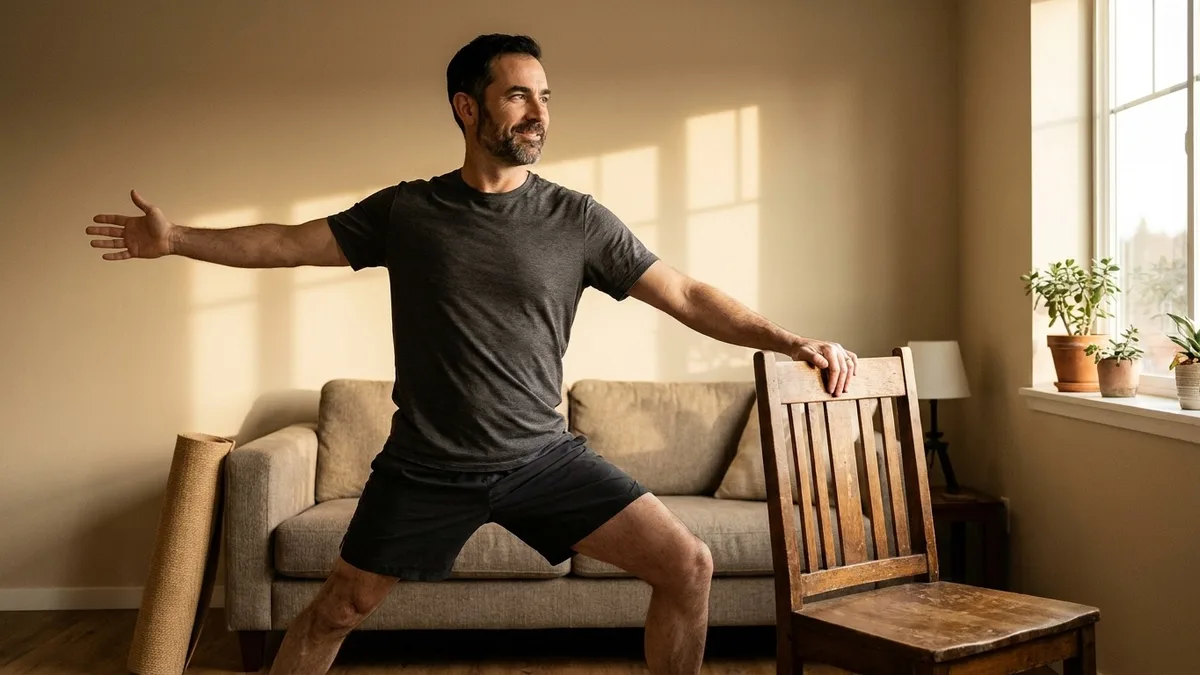
Stop scrolling if your belly is the thing you keep poking at in the mirror. You do not need a gym, a mat, or a single ounce of balance to start fixing it today.
Here is the deal this whole routine rests on: 30 minutes at home in the morning, 30 minutes at home in the evening, using one sturdy chair and moves simple enough that almost anyone can do them. No handstands, no floor work, no experience with yoga required.
That is the honest version of yoga for weight loss. It is not a magic burn. It is heat, strength, and a schedule you actually keep, and the eight moves below are the sequence to run, rep by rep.
Fear of falling is the number one reason people quit. So every balance-heavy move here has a chair behind it. Grab a non-wheeled dining chair and let’s get specific.
Quick Tips Before You Start
Chair First
Use a non-wheeled chair with a solid back and test it against a wall before your first rep.
Two Slots
Book 30 minutes in the morning and 30 in the evening; skip a slot and you have halved the work.
Three-Hour Gap
Eat nothing for 3 hours before either session so twisting and pressing stays comfortable.
Breathe Normally
Every rep in this routine is done on normal breath; holding your breath is the quickest way to feel sick.
Check With a Pro
If you have back, knee, or balance limits, clear the squat and knee-to-elbow with your doctor first.
1. The 30-Minute Daily Home Practice
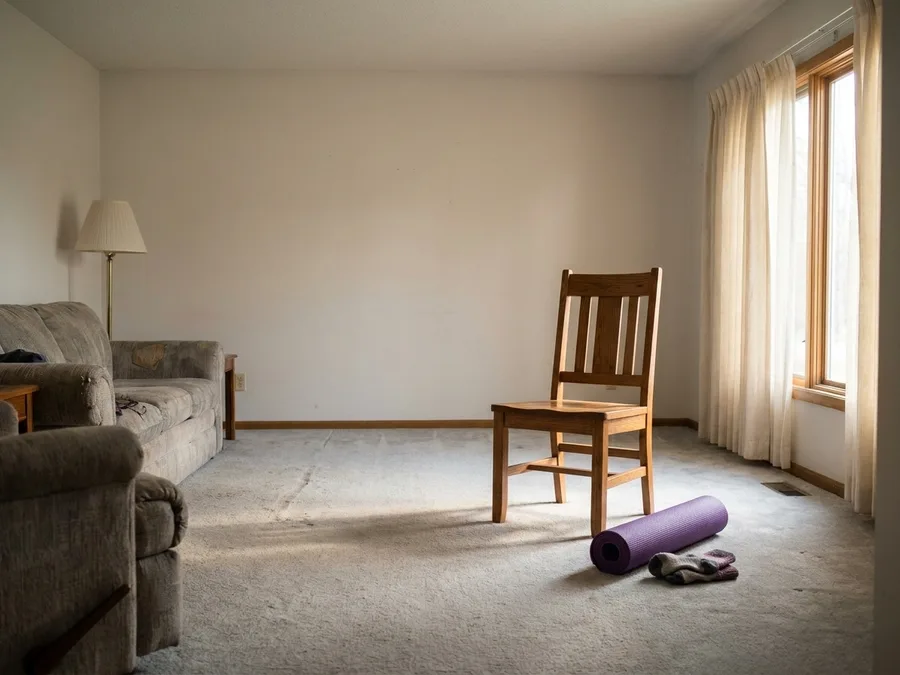
A studio class wants your evening, your flexibility and maybe $20 a drop-in. This routine asks for one chair and half an hour a day, and that is the whole entry fee.
It runs at home, in your own living room, and the moves are simple enough that almost anyone can do them. If your balance is poor, the chair becomes your handrail: you hold the back of it for the squat, you sit on it for the twist and the leg lift, and you never once balance on one foot in open space.
You do not need prior yoga experience, a mat, or special clothes. A dining chair, clear floor space to extend your arms, and bare feet or socks are enough; a mat is nice underfoot for the standing work, and carpet works just as well.
Thirty minutes is short enough to keep and long enough to get warm, and the eight moves each hit a different part of the job: waist, hips, chest, thighs, and a raised heart rate. If you want gentle moves that also support focus, brain-friendly yoga offers a calmer way to move on the days between sessions. One catch: make sure the chair has no wheels.
💡 Tip: Test your chair: push down hard on the backrest. If it slides or tips, move it against a wall or swap it.
| Part | What it is | Reps or timing | Main target / note |
|---|---|---|---|
| 1 | Daily home practice | 30 min morning and evening | Whole-body routine; chair for balance |
| 2 | Meal-time reset | 7:30–8, 12–1, 7–8 | Fixed windows; first habit to fix |
| 3 | Practice schedule | Two slots, no food 3 hrs before | Same eight-part order both sessions |
| 4 | Chair twist | 30 reps, alternating legs | Side belly; twist from the ribcage |
| 5 | Seated leg lift | 30 reps per leg | Back pain and side belly; works at a desk |
| 6 | Chest press | 30 reps each session | Chest fat claim; shoulders stay down |
| 7 | Chair-supported squat | 10–12 reps | Heat in thighs and glutes; knees over toes |
| 8 | Standing knee-to-elbow | 15–20 reps per side | Core heat without floor work |
2. The Fixed Meal-Time Reset
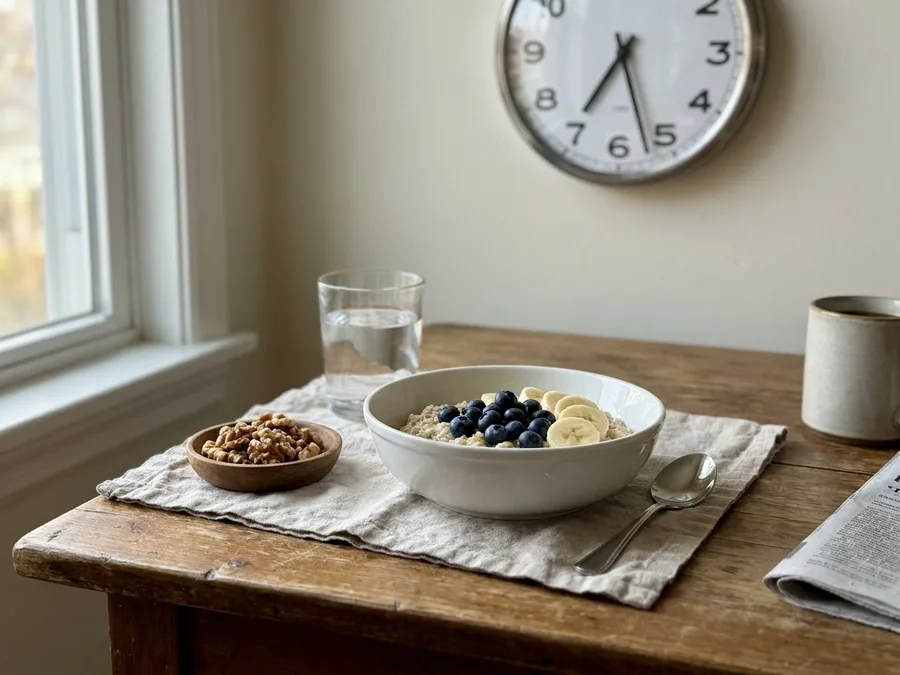
Because exercise is the second thing you fix. The clock comes first.
Belly fat tends to appear after a certain age, and grazing all day quietly makes it worse. Anchor three windows and hold them most days: breakfast between 7:30 and 8:00 a.m., lunch between 12:00 and 1:00 p.m., dinner between 7:00 and 8:00 p.m.
Fixed windows do two things. They stop the all-day picking that adds up without you noticing, and they make the 3-hour gap before practice easy to plan instead of a daily negotiation. Graze from 8 a.m. to 9 p.m. and that gap never opens.
💡 Tip: Set three phone alarms labeled breakfast, lunch, dinner. Move the dinner one earlier if a morning session keeps getting skipped.
3. The Morning-and-Evening Practice Schedule
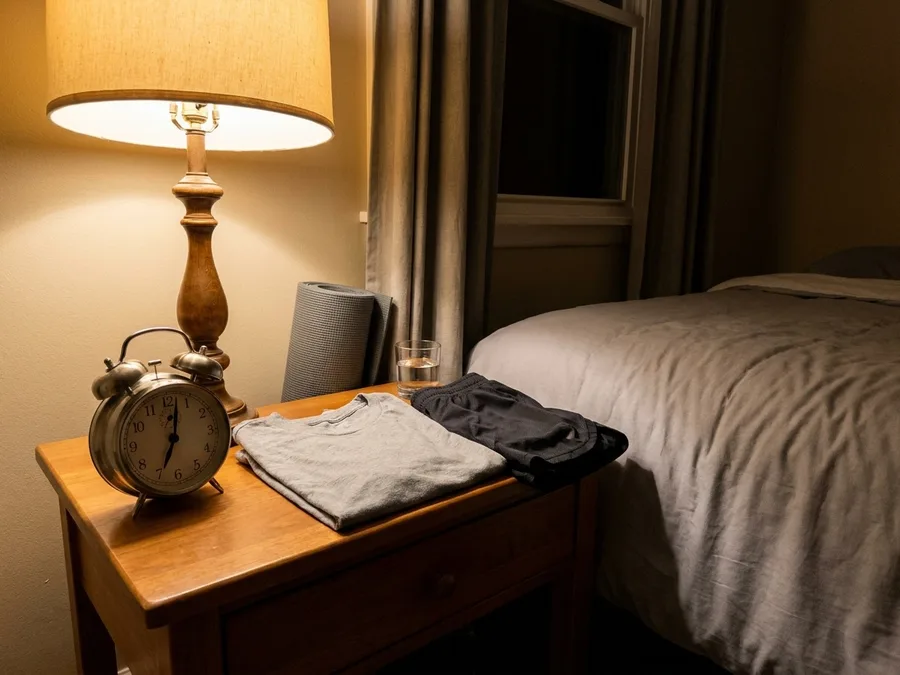
Picture 9 p.m.: dinner barely digested, dishes in the sink, and the second session still not done. That is the moment most people quit, so solve it on paper before it happens.
Do a half-hour session on rising and another half-hour at night, and eat nothing for 3 hours before either. With dinner at 7:00-8:00 p.m., that evening slot lands around 10 p.m., or you shift dinner earlier and take the evening session at 9.
For the morning slot, a 7:30 breakfast means you rise, move first, then eat. Both sessions use the same eight-part order, so you never waste a minute deciding what comes next.
The catch people miss is the second session, not the first. Morning yoga feels virtuous; evening yoga competes with dinner, dishes and television. Put it in the calendar like an appointment.
💡 Tip: Run the same eight moves in the same order both times. Familiar order means no thinking, and no thinking means you actually finish.
⚠️ COMMON MISTAKE
The Gap Is Not Optional
Twisting and pressing on a full stomach is the fastest route to nausea and a skipped session. If you ate less than 3 hours ago, wait it out rather than pushing through.
4. Chair Twist for Side Belly Fat
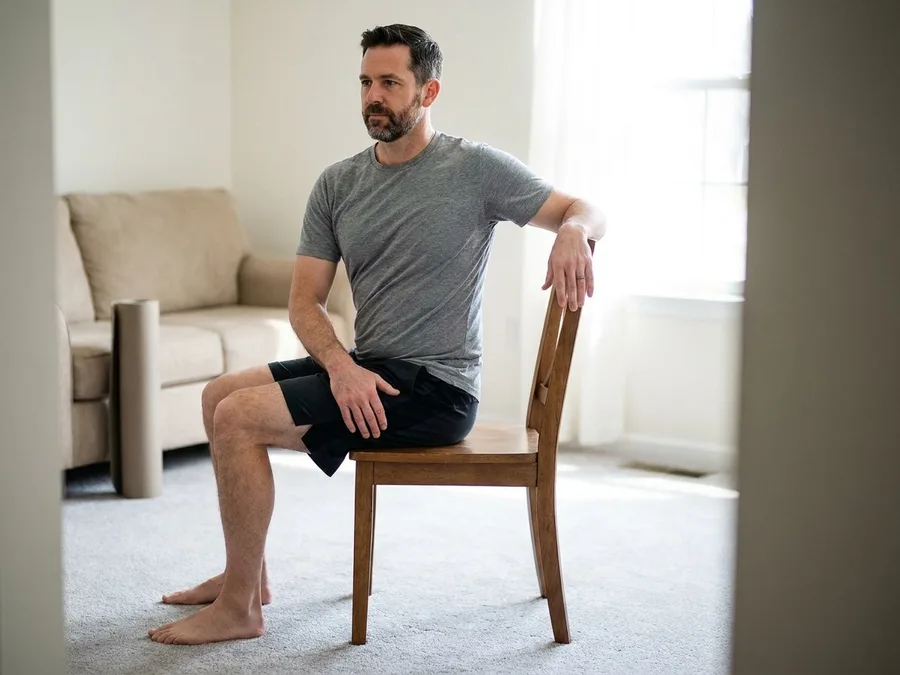
Once the meal windows and the two slots are locked in, the question turns to what you actually do in those 30 minutes. Start here if the waistband is where your weight sits, because the chair twist is the move to master first.
Sit square on a sturdy chair, feet flat, then lift one leg and twist your torso to the opposite side. That is one rep. Do 30 reps, alternating legs, breathing normally the whole way through.
The twist should come from your ribcage, not your neck, so keep the movement small and slow and let the shoulders follow the ribs rather than leading them.
Small beats big here. A short, controlled twist repeated 30 times keeps the low back safe and actually reaches the side waist, which is the spot most people are trying to change. Cranking hard and fast just pulls on the spine.
If you feel a pinch in your lower back, reduce the range by half and slow down. You should feel a gentle squeeze along the side of your waist, especially on the side you twist toward, and nothing sharp anywhere else. For example, aim for a twist of just a few inches at first and add a little only when 30 reps feel easy.
5. Seated Leg Lift for Back Pain and Side Belly

That ribcage-driven twist sets up the next move nicely because the leg lift works the same side waist from a different angle. Sit with your back straight, hold one leg with both hands, and lift it while pressing the thigh into your stomach.
Do 30 reps per leg, and both legs get a turn. You can do this sitting, standing, or at an office desk, which makes it the easiest move in the whole routine to sneak into a workday.
People report it easing back pain as well as trimming the side belly, and that makes sense: a straight-backed seated lift asks your deep core to hold you up while the hip does the work. Do not round your lower back to get the knee higher.
6. Chest Press for 30 Daily Reps
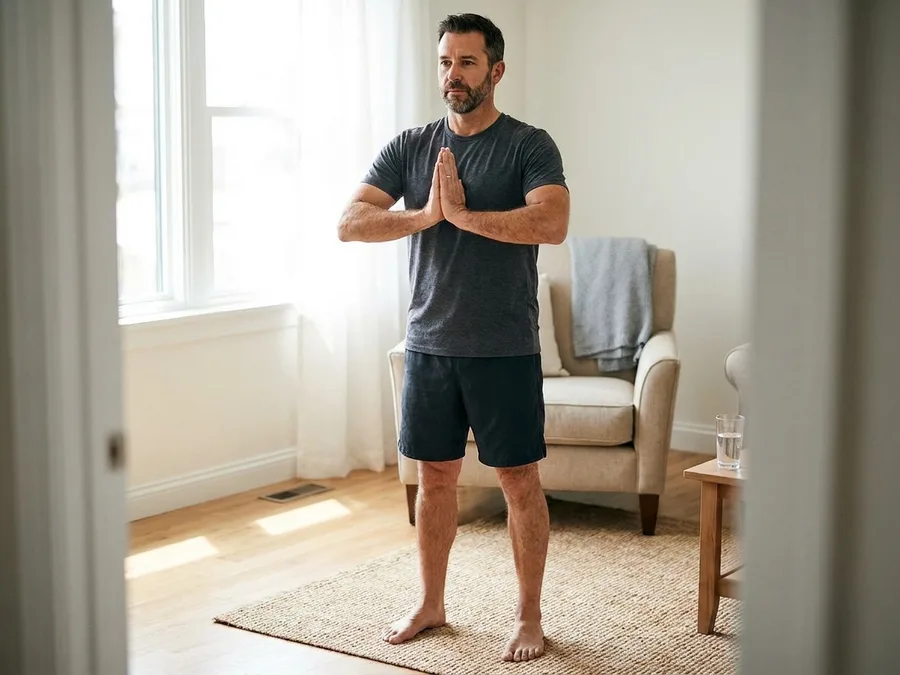
Press your palms together at chest height and push them hard, then release. That is the whole move. Thirty reps, every day, in each session, sitting or standing tall.
It is the easiest thing on the list and the one people quietly skip because it does not look like much. Do not let your shoulders creep up toward your ears and do not brace and hold your breath. Breathe normally and keep the shoulders down while your hands work.
Be honest about what this does. Pressing palm to palm builds strength through your chest and arms, but no exercise burns fat off the spot you are working. Spot reduction is a myth. Anyone promising a chest-fat move is selling a feeling, not a fact.
What you actually get is posture and tone. Stronger chest and arm muscles make the standing moves easier, and the upper body looks firmer as the weight comes down overall. Picture it: 30 presses, twice a day, shoulders relaxed, breathing steady. That is 60 a day, and none of them need a mat or a single minute on the floor.
Simple does not mean risk-free. Check these three before you stand up.
7. Chair-Supported Squat to Build Heat
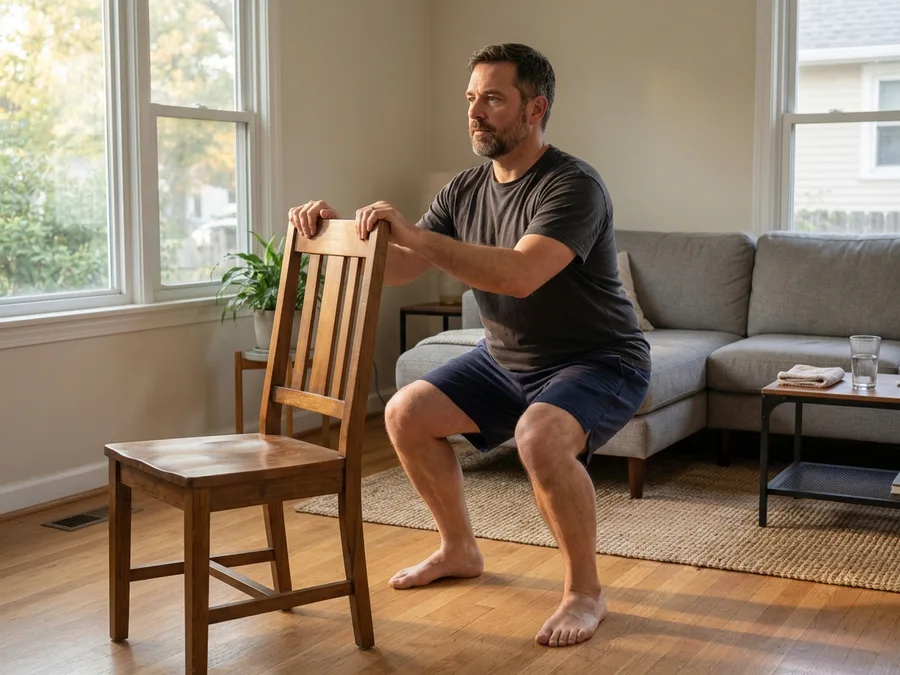
All that seated work builds control, but if you want to feel warm, you have to stand up. This is where the routine earns its sweat.
Stand behind a sturdy chair and hold the top of the backrest with both hands. Sit your hips back and down until your thighs are close to parallel with the floor, then press through your feet to stand. That is one rep, and you do 10 to 12 of them.
Keep your knees tracking over your toes and your chest lifted. If your knees cave inward on the way up, widen your stance a little and push them gently outward as you rise. Use the chair for your hands, not to take your weight, or the legs stop doing the work.
Here is why it matters. This move lifts your heart rate and loads the biggest muscles in your body, and big muscles working means real heat and a real calorie cost. Twelve controlled reps will leave your legs buzzing. Twenty sloppy ones will leave your knees complaining.
Say your thighs are parallel at the bottom and you do 12 reps: that is 12 sit-backs and 12 stands, roughly 45 seconds of honest effort. Do it once in the morning session and once in the evening, and by the second week those 12 will feel lighter.
💡 Tip: Lower for a slow count of three and stand for one. The slow descent is what makes 12 reps feel like 20.
🧘 A Full Session, Start to Finish
Warm up
Keep it easy for 3-5 minutes. Skip this and the first squat rep will feel cold and stiff.
Chair twist
Lift one leg and twist to the opposite side. 30 reps alternating legs, breathing normally. Do this before the leg lift – it wakes up the waist.
Seated leg lift
Back straight, hold one leg with both hands, press the thigh into the stomach. 30 reps per leg. Works sitting, standing or at a desk.
Chest press
Palms together at chest, sit or stand tall. 30 press-and-release reps every session – morning and evening.
Chair-supported squat
Hold the chair back, hips back and down, 10-12 slow reps. This is the heat-builder, so it comes before knee-to-elbow. Use the chair for balance, not to carry your weight.
Knee-to-elbow
Stand tall, bring each knee to the opposite elbow 15-20 times per side. Do this last among the active moves – it is the hardest to control when tired.
Cool down
2-3 minutes of seated side bends and a gentle twist. Then wait at least 3 hours before eating.
8. Standing Knee-to-Elbow for Core Heat
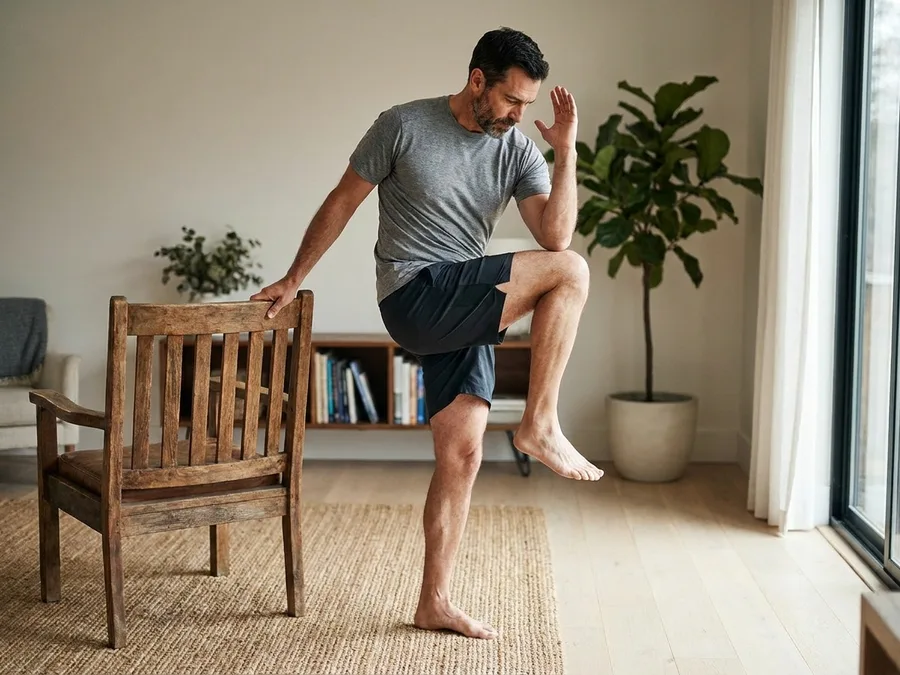
This last move finishes the job.
Stand tall, hold a chair back if you need it, lift one knee, and bring the opposite elbow toward it. Do 15 to 20 reps per side at a steady pace, and let your breathing stay natural rather than puffing hard.
The rhythm is what keeps your heart rate up, and the cross-body reach is what works the waist without any floor work at all. Keep your standing leg slightly soft and your back tall. If the chair is your balance aid, hold it lightly with one hand and reach only with the free arm.
You should finish warm and a little out of breath, not dizzy. If you can still chat in full sentences, pick up the pace; if you are gasping, slow down and keep the elbow reach shallow.
What Moves the Needle, What Does Not
Do this
- Both 30-minute sessions, morning and evening
- Fixed meal windows, three times a day
- A 3-hour gap between eating and practice
- Slow, controlled reps with normal breathing
- A solid chair against the wall for balance
Not this
- One long session, skipped on busy days
- Grazing from morning to night
- Twisting on a full stomach to save time
- Cranking the twist hard and fast from the neck
- Holding a wheeled office chair for support
Warm Up, Cool Down, and Breathe
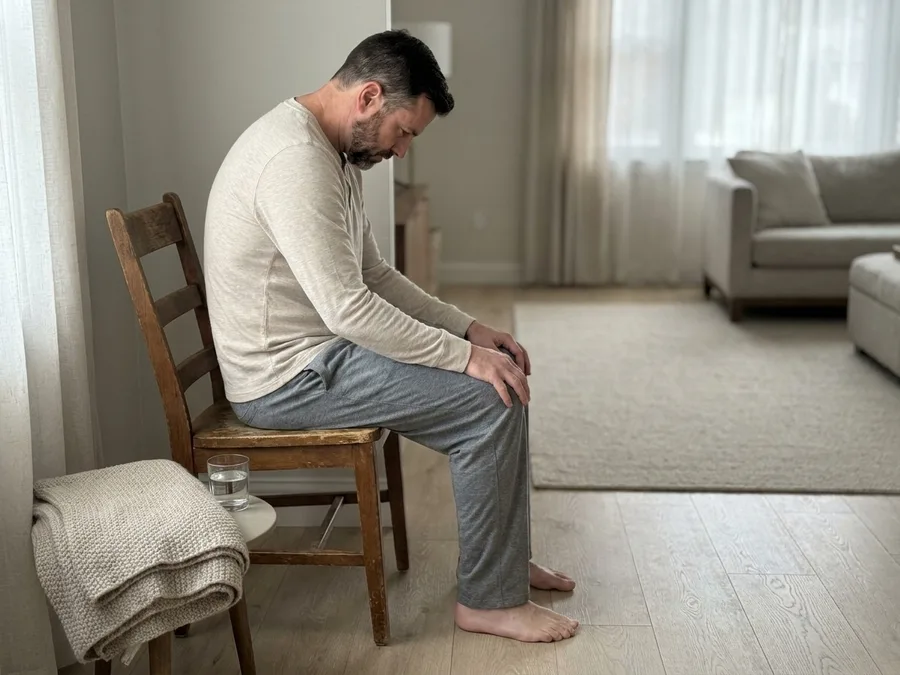
Do you need a warm-up before all this, and what do you do when it is over? Yes to both, and it takes minutes.
Before the first rep, spend 3 to 5 minutes marching in place, rolling your shoulders slowly forward and back, and moving through a seated cat-cow: sit tall, hands on knees, arch and round your spine a few times. That is enough to warm the joints and wake up the waist before you start twisting.
Through every rep in every move, breathe normally and never hold your breath. Holding it spikes your blood pressure and makes you tired faster, which is the opposite of what you want in a session built on rhythm and consistency.
Finish with 2 to 3 minutes of slow seated side bends and a gentle twist. In the final minute, breathe in for a count of four and out for a count of six. The long exhale tells your body the work is done, and it makes the next session far easier to start.
Set Three Meal Windows, Book Two Slots, Start With the Twist
Before any of the eight moves matter, three numbers do: 7:30 to 8:00 for breakfast, 12:00 to 1:00 for lunch, 7:00 to 8:00 for dinner. Put them in your phone now.
Then book the two slots, 30 minutes in the morning and 30 in the evening, and start with the two easiest moves at 30 reps each: the chair twist and the seated leg lift. Those alone will show you how the routine feels before you add anything harder.
If your back, knees, or balance are a concern, use the warm-up and safety notes first and leave the squat and knee-to-elbow out for now. Add them when the seated work feels easy.
Simple does not have to mean slow. Consistency is what turns eight chair moves into a habit, and the habit is the whole point.
Set Your Alarms Tonight
Three meal windows on the calendar and two 30-minute slots on the clock. Do that now, then run the chair twist and seated leg lift for 30 reps each.
