

Most people assume weight loss is a math problem, and they are half right. The arithmetic works until the third time you lose the same ten pounds and watch them return.
You have done the hard part already. The eating is reasonable, the weight came off, it came back, it came off again, and the scale has sat in the same place for months. What nobody counted is the rest of the week: a 6.5-hour night, a 4 pm snack habit three or four days out of seven, weekends that barely break 1,900 steps.
Diet is one input of four. The other three are sleep, stress and the steps your ordinary day already holds, and any one of them can stall a plate that looks fine on paper.
So the job is not another food rule. It is finding which of the three sits furthest from your own baseline, changing that one first, and paying nothing to do it.
| Lever | What to measure | Example starting point | First change this week |
|---|---|---|---|
| Sleep | Hours between lights-out and alarm | 6.5 hours (11:45 pm to 6:40 am) | Set a 6:30 am alarm for all seven days |
| Stress | Afternoon snacks eaten without hunger | 3–4 desk snacks a week, worst in deadline weeks | Pack fruit the night before and walk at 3:55 pm |
| Steps | Average daily step count, office day vs weekend | 5,200 on office days, 1,900 on weekends | Add a 15-minute post-dinner walk (~1,500 steps) |
Short Nights Show Up as Extra Eating

A short night does not weaken your willpower. It adds hours to your evening, and those hours get eaten.
Take the example week: bed at 11:45 pm, alarm at 6:40 am, about six and a half hours a night. Nothing in the kitchen changed, no rules were broken at dinner, and dinner had already been counted. Only the length of the evening changed.
It showed up on short nights and only short nights, and it arrived after the day’s eating was already logged and closed. This is why it feels invisible: it is not a meal and not a decision, it is a window opening because you are still awake and the kitchen is ten feet away.
After 40, the same short night also nudges appetite signals toward more eating the next day, so the window tends to stay open.
One Wake Time, Seven Days a Week

Anchor the morning and let the evening follow it. The 6:30 am alarm has to ring on all seven days, Saturday included, while the bedtime is free to float wherever it lands; because the morning never shifts, the night has nowhere to stretch to.
Catch-up sleep is where the trouble enters. Sleeping in until 8:30 am on a Sunday pushes that night’s lights-out past 12:30 am, which leaves Monday under six hours before the alarm. The weekday damage begins on the weekend, not on Monday.
The first fortnight is unpleasant and there is no way around that. A Saturday 6:30 am start feels punitive when the flat is quiet, and evenings run groggy from the accumulated debt; the body settles by the third week, not before it.
Work backward from whatever your morning cannot move. A 5 am shift start is fixed by the job, so keep that alarm steady and pull bedtime 15 minutes earlier each week until the two ends meet. Shift workers do the same with the main sleep block, anchoring it after the shift and holding it on days off.
Skip the lie-in only if your night is genuinely yours to set. Anyone rising for a toddler or a parent already knows the problem is not bedtime discipline, and an earlier alarm will not solve it.
⚠️ COMMON MISTAKE
A hard bedtime does not fix a caffeinated evening
Setting a 10:45 pm bedtime while a 4 pm coffee and a phone in the bedroom are still in play produces a 10:45 pm in bed and a 12:15 am lights-out. Cut the caffeine and move the charger first; the bedtime order only works once those two delays are gone.
A 2 pm Coffee Cutoff Changes the Evening

Two things push the night later once the wake time is fixed: late caffeine and the phone in the bedroom.
Coffee moved from about 4 pm to a 2 pm cutoff, eased through 3 pm. It took a week of 3 pm days before 2 pm held without a headache. Handle that gradually, one hour earlier at a time, rather than jumping straight to 2 pm and abandoning it on day three.
The phone went to a charger outside the bedroom, which removed the second delay: the last scroll that turned 10:45 pm into 12:15 am.
That gap is the point. A hard bedtime set while caffeine and the phone were still in play produced a 10:45 pm in bed and a 12:15 am lights-out. The cutoff worked where the bedtime order failed, because it removed the cause instead of asking for willpower at the exact moment willpower is lowest.
One honest limit. This will not fix a night genuinely shortened by children or caregiving. There the fix is coverage: another adult takes the 6:30 am wake on set days so you get two or three full nights a week, not an earlier bedtime that never arrives.
Stress Eating Is a Bad-Day Habit, Not Weakness

A short night and a 4 pm snack are the same problem arriving twice. The snack that shows up three or four days a week is rarely hunger and rarely a decision, and the trigger usually has a name: a hard meeting, a crowded inbox, a deadline that landed that morning. Notice the order. The trigger comes first, the snack follows, and by then the day has already gone sideways.
What makes it feel like weakness is the location. It happens at the desk, in front of the screen, in the middle of something else, so there is no moment where a choice seems to occur. There is just the wrapper in the bin at 4:15 pm.
The fix that holds is planned the night before, not resisted at 4 pm, because by mid-afternoon willpower is the wrong tool. Put fruit in the drawer the night before, and set a five-minute walk to the far kitchen at 3:55 pm with the route already chosen. The walk breaks the trigger before it reaches the desk.
Know where this does not apply. If the eating is not tied to stress at all, if it is a portion pattern or an ordinary hunger rhythm, this swap will not touch it, and a different fix is needed.
Two ways to handle the 4 pm moment
Resisting at the desk vs. planning the night before
One Bad Week Doesn’t Undo a Good Month

A single bad week typically costs around 3 lb on the scale, and most of that comes back off within a month once normal rhythms return. The deadline week in the example ran five straight days: late nights, food eaten at the desk, and no walks at all. The scale jumped 3 lb by Friday, but the damage was smaller than it read.
What followed was three days of ordinary living. Meals went back to what they had been, bedtime returned to 10:45 pm, and the post-dinner walk resumed. The calorie intake was not slashed, no penance workout was added, no day of fasting followed.
That restraint is what makes the reset work. The 3 lb was gone within a month, which means the slip was never the real story. The speed of the return was.
The counterweight matters here. A reset only works if there is a good month behind it to reset to. Three weeks of the plan holding beforehand gives the body a pattern to snap back into.
What actually helps after a bad week
Do
- Return to normal meals and your usual bedtime
- Resume the walks at the same time of day
- Give the scale a month before judging the week
Don't
- Cut food further to compensate
- Double the exercise as punishment
- Add a second app and a stricter count
Dropping One Commitment Beats Adding Another Rule

If you want more good months, take something off the calendar rather than adding a rule to it. A weekly evening committee meeting, two hours in the room plus forty minutes of travel, returns about three hours to the week. That is the same three hours that the good-month weeks were quietly borrowing from.
The approach that fails is adding: a second app, a stricter count, both started in the same month, both abandoned inside a fortnight. Two weeks of that is all most people manage, and the failure costs more than the time did.
Be clear that there is a trade. Handing over the meeting took two conversations, and someone else now runs it. That is a cost paid, not a free win, and it is worth naming out loud before you commit to it.
This does not suit every week. If yours is already clear of anything optional, cutting further just removes things you need, and the better move is to protect the sleep block instead of trimming more from it.
Walking Survives the Weeks the Gym Doesn’t

A cleared week is worth little if nothing in it moves, and walking is the one form of movement that keeps happening when the week turns messy again.
Look at where the example week actually spends its steps: about 5,200 on a day at the office, but only about 1,900 once the weekend arrives. The low point is Saturday, not Tuesday, and most people assume the opposite.
The gym told a different story. A January sign-up produced eleven visits in five months, then lapsed quietly and stayed lapsed. The walking was still going in month six, never booked, never paid for.
Weather and travel do not have to end it. Take the stairs instead of the lift, walk a loop of the flat, park further round the shop and walk the extra stretch. Rain changes the route, not the habit.
One honest limit: walking builds very little strength. It is the floor of the plan, not the whole of it. Two short bodyweight sessions belong in a later month, once the walking is holding through a bad week. Knowing how walking and strength training compare makes it easier to decide how to sequence the two.
Walking vs. the gym — At a Glance
📅 Baseline to build from
5,200 office days / 1,900 weekends
🎯 Week-four target
7,000 a day, added in 1,500-step blocks
⏱️ Quickest block
A 15-minute post-dinner walk earns about 1,500
🔄 Realistic recovery
A bad week cost 3 lb and it returned within a month
💰 Spend to start
$0 to $40 for an app or used step counter
Watch for
The drop is Saturday, not Tuesday — and don't stack bodyweight sessions until walking holds through a bad week.
The First 2,000 Steps Are the Easiest to Add

A day already full does not have to give up time for steps; the first extra ones bolt onto things already happening. The parking spot moves to the back of the lot, lunch gains one loop around the block, phone calls get taken on your feet instead of at the desk.
The progression is deliberately unambitious. From 5,200 a day to 6,700 across the first fortnight, then 7,000 by the end of week four, built in additions of about 1,500 with a smaller top-up to finish.
The whole thing adds roughly 25 minutes of walking across the day, in pieces too short to need a change of clothes or a shower. That is why it survives a week with a deadline in it.
Nothing has to be bought. A phone app or a used step counter covers the counting at $0 to $40, and the count is optional at that.
If the count is not wanted, the loop and the back of the lot still work exactly as well. The steps happen either way; the number is only there to tell you where the weekend low point is.
🚶 Building to 7,000 steps in four weeks
Week 1
Stop bolting extra steps onto deadline days; a missed day gets an easy 1,500-step make-up on Saturday.
Week 2
If the count stalls near 6,700, add 200 easy steps to the office day before adding another loop.
Week 4
7,000 is the floor, not the goal; the weekend day at 1,900 is the number to watch.
Week 5 onward
If you stop counting, keep the two moves that cost nothing; the walking happens either way.
A Post-Dinner Walk Replaces the Snacking Hour

The most useful walk of the day is the short one that starts fifteen minutes after dinner and covers roughly 1,500 steps, because it takes the place of an hour already sitting in your evening.
Think about what occupies that hour now: the couch, the television, and the 9:30 pm window where the snacking happens without a decision. The walk fills the same slot, and it ends after the kitchen has closed.
Dark evenings and rain have answers. Walk a loop of the flat, or move the same walk earlier, before the light goes. The slot matters more than the route, and fifteen minutes of hallway and living room still counts as the walk.
Of the three levers, this is the easiest to start tonight. No cost, no booking, no change to the schedule, no equipment to find. Put the shoes by the door and go when the plates are cleared.
💡 PRO TIP
Use the lower day as your target
Most people set their step target from their best day. Set it from your worst: if weekends sit near 1,900 and office days near 5,200, the weekend is where the next 1,500 steps belong.
Your Own Baseline Beats Any Round Number

The number to aim at comes from your own week, not from a round figure someone else picked.
In the example week that meant noticing the spread: roughly 5,200 steps on an office day against about 1,900 on a weekend day, a gap of more than 3,000 between the two halves of the same life. A target set against the office day looks achievable and does nothing, because the weekend is where the floor actually sits. The target has to clear the lower day.
The first attempt did the opposite. It went from 5,200 straight to 10,000 in week one, held for nine days, and collapsed back to 5,000 – a round number borrowed from somewhere, defended for a week and a half, then dropped.
What held was smaller and slower: add about 1,500 steps, stay there two weeks, then add the next. That is 5,200 to 6,700 in the first fortnight and 7,000 by week four, and each step up is small enough that a bad Tuesday does not end it.
When a plateau lands around 9,000, hold it for two weeks before doing anything. Then add to the weekend day – the 1,900 one – rather than pushing the office day higher; the low day has the room, and topping up the day you already walk well on just makes a good day longer.
Six months, in numbers
What the three levers added up to
The plan: a 6:30 am alarm seven days, bed by 10:45 pm, coffee cutoff at 2 pm, phone outside the bedroom.
Pick the Lever Furthest From Your Baseline
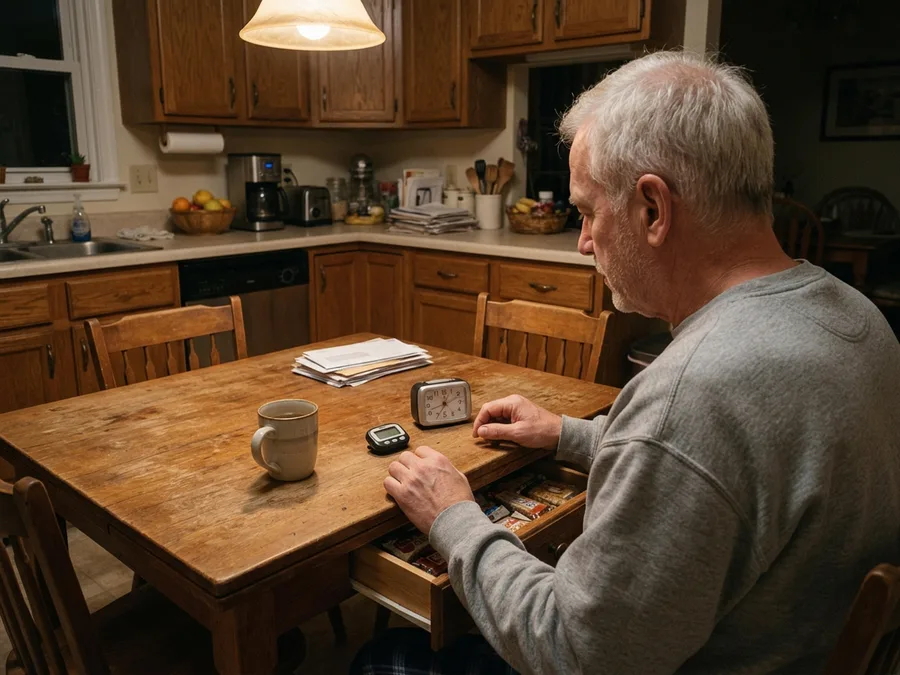
You fix one lever, not three. Go back through your own week and compare it honestly against the examples above, then pick whichever sits furthest from baseline, which is not always the one you like least. The worst number wins, because that is where the cheapest change is waiting.
The test is quick. If your evenings stretch past 11 pm with a phone still in the room, sleep is your lever. If your afternoons collapse into desk snacks three or four days a week during deadline weeks, stress is. If your weekends sit under 2,000 steps while your workdays look reasonable, movement is the one that goes first.
When two are close, take sleep. It is free, it needs no booking and no equipment, and an earlier night quietly shrinks evening eating in a way no food rule manages, because the 9:30 pm snack only exists when the evening runs long. That is why it is the usual first pick for anyone whose eating already looks reasonable.
Then your first action this week is one item, not three. Set the 6:30 am alarm for seven days running, or fix the 3:55 pm walk route through the far kitchen, or park at the back of the lot and walk in. Pick the one that matches the lever you just named, and leave the other two alone until it holds.
Fix the worst number in your week, then leave the other two alone
Whichever of the three sits furthest from your own baseline is the one to fix, and for most people that is sleep: free, no food rule attached, and it removes the 9:30 pm eating no amount of willpower was going to police.
Take one action this week, not three. The 6:30 am alarm seven days running, or the 2 pm coffee cutoff if your nights are already full. Add 1,500 steps a day only after two weeks of it holding and the evenings or the scale moving.
You came in eating reasonably and still stuck, and that was half right. The diet was never the whole story; the evening snack and the 1,900-step weekend were, and six months of this put the illustrative 41-year-old about 18 lb down, with the worst week costing 3 lb that came back off within a month.
Which lever is furthest from your baseline?
Write down your usual bedtime, your worst afternoon, and your weekend step count. The worst of the three is the one you fix first — this week.
