

You hit your 40s, the scale gets harder to move, and everyone tells you the same thing: your metabolism has slowed down after 40.
That explanation sounds neat. But it can send people chasing the wrong solutions while muscle loss, less daily movement, menopause, sleep problems, medications, or health conditions quietly change what is happening inside the body.
Joseph spent 20 years studying metabolism, and the biggest surprise was this: the popular idea of a metabolic cliff at 40 does not match the strongest research.
The real story is more useful, because many of the things that change in midlife can actually be addressed.
The Metabolic Slowdown After 40 Does Not Start at 40

One of the most important metabolism studies ever conducted followed a far bigger age range than most earlier research.
Published in Science in 2021, the study analyzed daily energy expenditure data from 6,421 people across 29 countries. Participants ranged from just 8 days old to 95 years old. Researchers used doubly labeled water, a well established method for measuring energy expenditure while people live their normal lives.
The surprising part came after researchers accounted for body size and fat free mass.
From roughly age 20 through 60, adjusted energy expenditure was remarkably stable. Researchers did not find the dramatic metabolic collapse at 30, 40, or even 50 that many adults have been taught to expect.
A clearer decline appeared after about age 60. That later change was associated with declining fat free mass and physical activity, although changes in the metabolism of organs may contribute as well.
That finding does not mean everyone’s calorie needs stay identical between 20 and 60. It means age itself does not appear to flip a metabolic switch at 40 once major differences in body size and composition are taken into account.
Population research cannot explain why one specific person is gaining or losing weight. Unexpected changes in weight, appetite, energy, or other symptoms deserve individual medical advice rather than being automatically blamed on age.
What You Call “Metabolism” Is Really Several Different Things
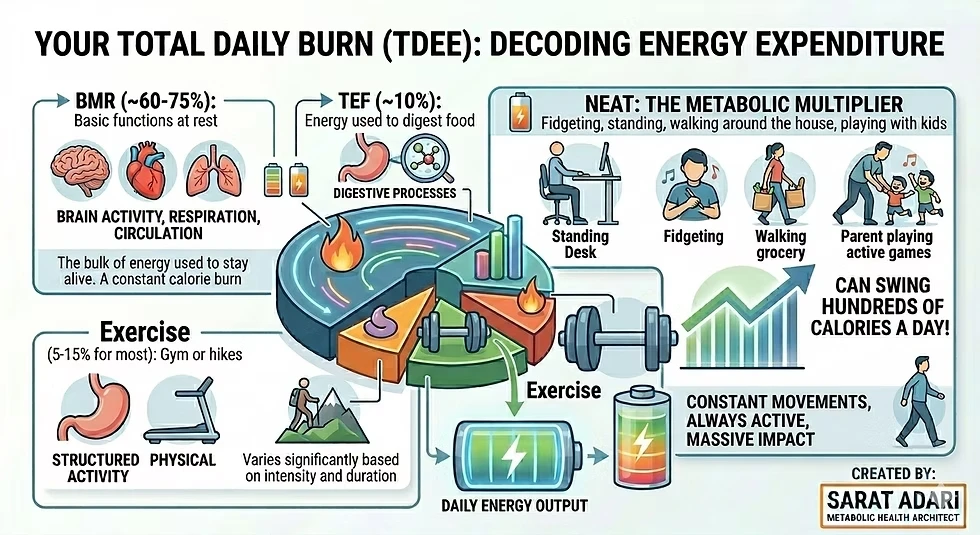
Part of the confusion starts with the word metabolism itself.
People often use it as if the body has one internal dial labeled fast or slow. Daily energy expenditure is actually built from several components.
Basal metabolic rate covers the energy needed for basic functions such as breathing, circulating blood, maintaining hormone levels, and repairing cells. Mayo Clinic notes that muscle mass is an important factor in basal metabolic rate.
Digesting and processing food also requires energy. Mayo Clinic estimates this accounts for about 10% of the calories consumed.
Then there is movement. That includes formal exercise plus walking around the house, gardening, housework, standing, and even fidgeting.
| Part of Daily Energy Use | What It Means | What Matters After 40 |
|---|---|---|
| Resting energy | Energy needed for breathing, circulation, cell repair, and other basic functions | Body size and muscle mass strongly influence it |
| Food processing | Energy used to digest, absorb, and store nutrients | Roughly 10% of calories eaten are used in this process |
| Planned exercise | Walking, cycling, swimming, resistance exercise, and other workouts | Amount and intensity can change daily expenditure |
| Everyday movement | Standing, chores, walking around, gardening, and fidgeting | Mayo Clinic estimates this type of movement can account for roughly 100 to 800 calories daily |
| Body composition | The body’s mix of lean tissue, fat, bone, and other tissue | Losing muscle can change energy needs even without an age 40 metabolic cliff |
This helps explain why two 48 year olds can have very different energy requirements.
They may be the same age, yet have different amounts of muscle, different jobs, different sleep patterns, and dramatically different levels of everyday movement.
So, Why Can Your Body Feel So Different at 45?

This is where the metabolism myth becomes convincing.
Your metabolism does not need to suddenly collapse for your waistline, strength, or calorie needs to change.
Suppose someone at 32 walked to work, climbed stairs, carried children, spent weekends outdoors, and rarely sat for eight uninterrupted hours. At 47, that same person may exercise three times a week but spend most working hours in a chair.
Mayo Clinic calls everyday movement outside planned exercise nonexercise activity thermogenesis, often shortened to NEAT. It includes ordinary activities such as housework, walking around, gardening, and fidgeting.
Mayo Clinic estimates NEAT can account for roughly 100 to 800 calories per day. That wide range shows why focusing only on a 30 minute workout can miss much of the daily movement picture.
The person may feel that metabolism has slowed. In reality, part of the difference may be how much the body moves during the other waking hours.
Muscle Can Change Before Age Becomes the Main Metabolic Issue

Muscle deserves special attention after 40 because lean tissue is closely tied to energy requirements.
Mayo Clinic identifies muscle mass as a key determinant of basal metabolic rate. It also explains that people tend to lose muscle as they age, while a greater share of body weight may come from fat.
This does not mean adding a few pounds of muscle will suddenly turn someone into a calorie burning furnace. Claims that each pound of muscle burns enormous numbers of calories at rest are often exaggerated.
The more useful reason to protect muscle is broader.
Muscle supports strength, mobility, physical function, and the ability to remain active. Maintaining it also helps protect body composition as the years pass.
Current CDC guidance recommends adults get at least 150 minutes of moderate intensity aerobic activity each week, or 75 minutes of vigorous activity, plus muscle strengthening activity on at least 2 days each week.
For Women, Menopause Makes the Answer More Complicated

Women who say their bodies changed during their 40s or 50s should not be told that they imagined it.
Menopause can overlap with changes in body composition, sleep, activity, and where body fat is stored. Those changes can make midlife feel dramatically different even when age alone has not caused a sudden metabolic shutdown.
This is an important distinction.
The claim that every woman’s metabolism automatically crashes at 40 is too simple. So is the opposite claim that nothing meaningful happens during midlife.
A woman who is sleeping poorly because of menopausal symptoms, losing lean tissue, moving less, and accumulating more abdominal fat may experience a very real change in weight and body composition.
That experience deserves a better explanation than, “You turned 40, so your metabolism is broken.”
The Bigger Change May Be Happening Outside Your Workout

Exercise matters, but the rest of the day matters too.
A person can complete a morning workout and still spend most of the next 12 hours sitting. That is one reason Mayo Clinic emphasizes both structured exercise and everyday movement.
CDC guidance makes a similar point with a simple message: move more and sit less. Some activity is better than none, and activity can be accumulated in smaller chunks rather than completed all at once.
| Midlife Change | Why It Matters | Practical Response |
|---|---|---|
| Less muscle | Can affect strength, function, and resting energy requirements | Strengthen major muscle groups at least 2 days each week |
| More sitting | Reduces opportunities for daily energy expenditure | Break up long sitting periods and create reasons to walk or stand |
| Menopause | Can coincide with changes in sleep, lean tissue, and fat distribution | Discuss disruptive symptoms with a healthcare professional and protect activity and muscle |
| Poor sleep | Can affect energy, appetite, and willingness to be active | Address persistent sleep problems rather than accepting them as normal aging |
| Gradual intake changes | Small changes repeated daily can matter over months and years | Focus on sustainable portions and filling, nutrient dense foods |
None of these actions “restarts” metabolism.
They address the parts of midlife health that are actually changeable.
What Actually Helps After 40

The first target is muscle.
CDC guidance recommends muscle strengthening activities at least twice each week. Examples include weights, resistance bands, and exercises that use body weight for resistance.
For strength work, CDC suggests working the major muscle groups. A set can include roughly 8 to 12 repetitions, performed to the point where another repetition would be difficult without help.
The second target is movement between workouts.
A brisk walk is useful, but so are stairs, gardening, household tasks, walking during a phone call, and other reasons to spend less of the day sitting.
The third target is food quality rather than metabolism tricks.
Meals that provide appropriate protein can help support muscle, while vegetables, fruits, whole grains, and other nutrient rich foods can make a balanced eating pattern easier to sustain.
Individual protein and calorie needs vary. A person with kidney disease or another condition affecting nutrition may need advice tailored to their medical situation.
Exercise and nutrition needs vary with health, medications, mobility, and existing medical conditions. Check with a qualified healthcare professional before making a major change to your eating or exercise routine if you have a health condition or have been inactive.
Try This This Week
- Strengthen twice. Choose two days for resistance exercises that work the major muscle groups.
- Break up sitting. Look for regular opportunities to stand, walk, or complete a small task rather than remaining seated for long stretches.
- Add purposeful movement. Work toward the CDC goal of at least 150 minutes of moderate activity per week if appropriate for your health.
- Build meals around real food. Include an appropriate protein source and nutrient rich plant foods rather than relying on metabolism products.
- Watch your sleep. Persistent sleep problems deserve attention, especially when they appear alongside changes in appetite, energy, or weight.
Coffee and “Metabolism Boosters” Are Not the Rescue Plan
This is where marketing gets ahead of physiology.
Coffee, spicy foods, supplements, fasting schedules, and other products are often promoted as ways to “fire up” metabolism after 40. Even when something produces a small temporary effect, that is very different from permanently resetting basal metabolic rate.
Mayo Clinic specifically warns that products claiming to speed metabolism often fail to live up to their claims. Some supplements can also cause unwanted side effects.
The less exciting approach has much stronger footing: move regularly, preserve muscle, eat appropriately, and stop treating age 40 as a metabolic diagnosis.
The Real Metabolism Timeline Is Surprisingly Different
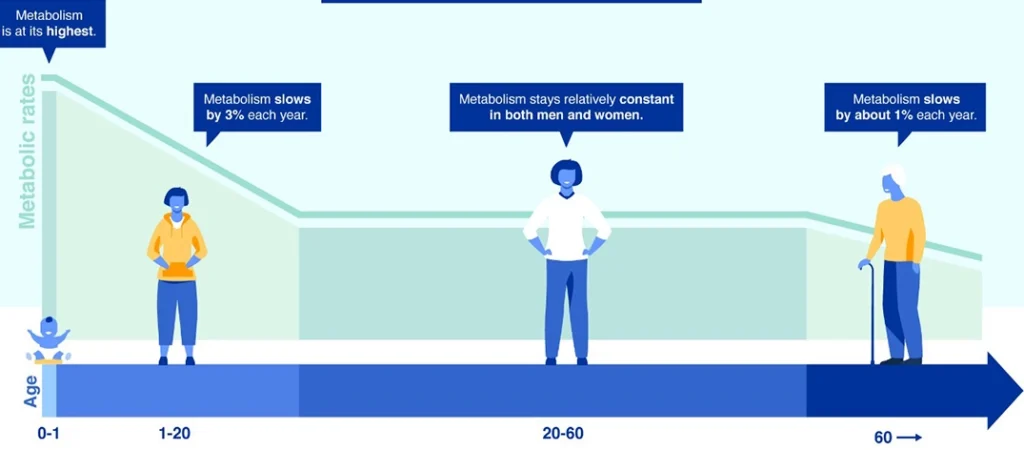
The 2021 Science research offers a useful way to view metabolism across an entire lifetime.
The researchers found distinct phases rather than a smooth slide beginning in middle age.
| Life Stage | What Researchers Found | What It Means |
|---|---|---|
| Infancy | Energy expenditure relative to body size rises rapidly | Metabolic demands are exceptionally high early in life |
| Childhood and adolescence | Adjusted expenditure gradually moves toward adult levels | Growing bodies follow a different energy pattern from adults |
| About 20 to 60 | Adjusted adult energy expenditure remains relatively stable | No universal metabolic cliff appeared at 40 |
| After about 60 | Energy expenditure begins a clearer decline | Changes in lean mass and activity contribute, with other biological changes also possible |
| Very old age | Energy expenditure is lower than during midlife | Later life is where the age related decline becomes more pronounced |
These are averages across populations, not calorie prescriptions for individuals.
Two people of the same age can still have very different bodies, activity patterns, health conditions, and energy needs.
When Weight Change Should Not Be Blamed on Age
Sometimes the problem really does need medical attention.
Cleveland Clinic advises seeing a healthcare provider for unexplained gains of about 2 to 3 pounds in a day, 5 pounds in a week, or 5% or more of body weight within a month. Rapid gain can sometimes signal an underlying condition rather than ordinary fat gain.
Unintentional weight loss matters too. Cleveland Clinic considers losing more than 5% of body weight or about 10 pounds over 6 to 12 months without trying concerning, particularly in older adults.
Red Flags: Call Your Doctor

- Rapid unexplained weight gain, particularly with swelling or other new symptoms.
- Significant weight loss without trying, especially when eating and activity have not changed.
- Persistent unusual fatigue or major changes in appetite or energy that do not have an obvious explanation.
- New symptoms alongside weight changes, rather than weight changes occurring alone.
A thyroid disorder, medication effect, fluid retention, or another medical condition can sometimes sit behind what looks like “bad metabolism.” Mayo Clinic notes that hypothyroidism and Cushing syndrome are among medical conditions that can contribute to weight gain, although medical conditions rarely explain large amounts of weight gain through slowed metabolism alone.
After 40, Ask a Better Question

Joseph’s biggest takeaway from 20 years studying metabolism is simpler than most metabolism advice: 40 is not a metabolic expiration date.
The strongest large study found that adjusted adult energy expenditure stayed remarkably stable from about 20 to 60. But that does not mean a person’s body, habits, hormones, muscle, or health stay unchanged for four decades.
That distinction changes the question worth asking.
Instead of, “How do I speed up my metabolism after 40?” ask, “What actually changed?”
Maybe movement dropped. Maybe strength training disappeared. Maybe sleep became poor, menopause changed body composition, eating habits shifted, or a medication or health problem entered the picture.
Those possibilities are far more useful than blaming a birthday.
There is no need to hunt for a tea, powder, spice, or morning ritual that supposedly restarts metabolism. Protect muscle, keep moving, eat in a way that supports health, take sleep seriously, and investigate changes that do not make sense.
Your metabolism did not receive a message on your 40th birthday telling it to shut down.
And that may be the most useful part of getting the science right.
This article is for informational purposes only and is not a substitute for professional medical advice, diagnosis, or treatment. Talk with your doctor or another qualified healthcare provider before making significant changes to your diet or exercise routine, especially if you have an existing medical condition, take medication, or are experiencing unexplained changes in weight or health.
:::
:::
