

In 1961, a 22-year-old woman named Jean walked down the aisle of a Dayton, Ohio church in a wedding dress with a 23-inch waist. She wore the same dress, at the same waist, to her daughter’s wedding in 1989. That’s 28 years and four children later, with no calorie counting, no gym membership, and no food journal.
Jean’s kitchen had no meal plan taped to the fridge. She never used the word diet except to mean what you eat. There were no forbidden foods, no point systems, no before-and-after photos. What she had were ten habits woven so deeply into daily life that naming them never occurred to her. Nobody around her named them either, since this was simply how the whole street ate.
Then something changed. Not the women. The food around them was rebuilt, deliberately, to make those ten habits almost impossible to keep. Most of them cost nothing and required nothing. The products that replaced them have monthly delivery options.
Quick Tips Before You Start
Start with breakfast
Two eggs and a slice of toast will hold you until noon better than any bar or shake.
Shrink the plate
A 9-inch dinner plate looks full with less food, and your brain reads full before your stomach does.
Set three meal times
Pick breakfast, lunch, and dinner hours and stick to them for a week before changing anything else.
Audit your drinks
Water, milk, and black coffee are the defaults. Everything else is a treat, not a habit.
Read the first five ingredients
If sugar or corn syrup is in the top five, put it back. Start with bread, sauce, peanut butter, and dressing.
1. Nobody snacked because snacks barely existed
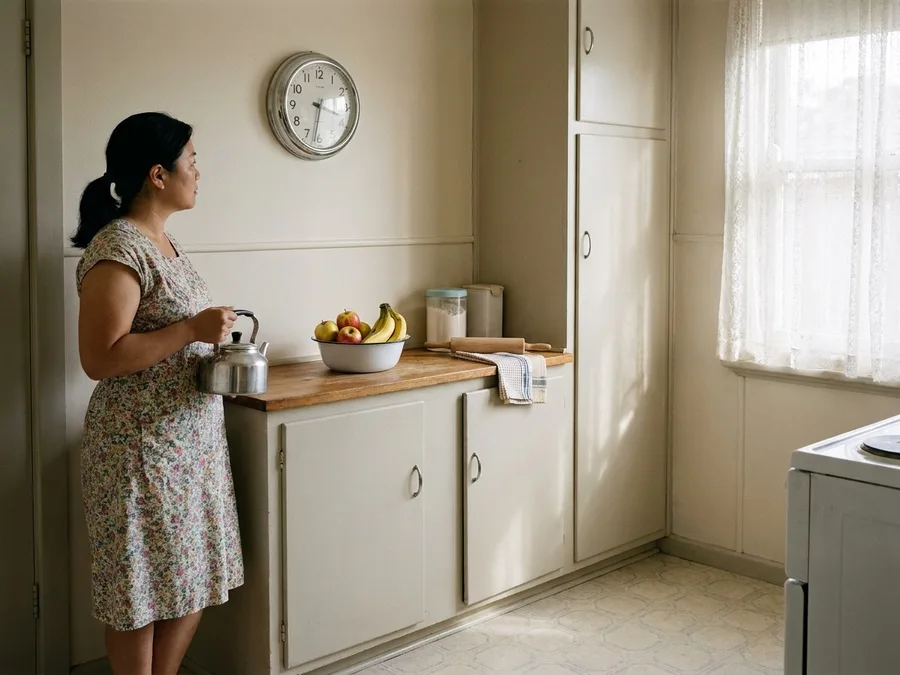
That gap between meals didn’t get filled by willpower. It got filled by an aisle that hadn’t been built yet.
In Jean’s house the kitchen had a rule nobody had to enforce: you ate at meal times, and between meals the kitchen was not a place you went. Doritos arrived in 1966. Pringles came in 1968. Before them there was no snack category, and today snacks bring in $18 billion a year. The industry expanded by manufacturing appetite first, making snacking feel like a need, and then selling the product that fills it.
The grazing lifestyle was not biology. It was a business model. Hunger at 4 p.m. wasn’t treated as something a few crackers could fix. It was proof that dinner would taste good.
So what do you do with real 3 p.m. hunger now? Find the trigger first, because half the time it’s the meeting you’re dreading or the water you haven’t drunk. Try a glass of water and ten minutes. If it’s still there, eat, but eat something that was food before it was a product, like an apple with a spoon of peanut butter or a hard-boiled egg.
💡 Tip: Find your trigger first. If it's boredom, a glass of water and ten minutes usually ends it. If it's real hunger, eat a small handful of nuts or a piece of fruit and then wait for dinner.
| Habit | 1950s–60s | Today | The gap |
|---|---|---|---|
| Snacking | Noendween-meal category | $18 billion snack industry | A problem invented and sold |
| Breakfast | Two eggs, toast, milk — 20 cents | $35 billion on-the-go market | Real food replaced by a product |
| Plate size | 9 inches across | 12 inches across | About 50% more surface area |
| Added sugar | 23 lb per person per year | 57 lb per person per year | The extra sits in bread and sauce |
| Coffee | 2 calories a cup | 300–600 calories a drink | Syrup and milk, not coffee |
| Bread ingredients | 4 (flour, water, yeast, salt) | 30+ on a modern loaf | A chemistry set in a bag |
2. Breakfast was eggs and toast, not a product

A Tuesday in 1959. Waking to the alarm at 6, two eggs cooked in butter, toast from the bakery, a glass of milk. About 20 cents all in.
The breakfast-on-the-go market is now worth over $35 billion, and it replaced something with no wrapper, no ingredient panel and no marketing budget. Research in the American Journal of Clinical Nutrition found that whole-food egg protein produces a stronger satiety hormone response than processed breakfast alternatives.
If eggs are out, keep the shape of it rather than the egg. Full-fat yogurt with nuts, or last night’s leftovers eaten sitting down, both work, because the sitting down is half of it.
💡 Tip: If eggs are out, try full-fat Greek yogurt with nuts, or last night's leftovers. The point is real-food protein and sitting down to eat it.
💡 PRO TIP
The one swap to make first
If you only do one thing after reading this, eat two eggs and a slice of toast for breakfast tomorrow, and sit down while you eat it. It costs about 20 cents and it changes the rest of the day.
3. Nine-inch plates quietly set the portion
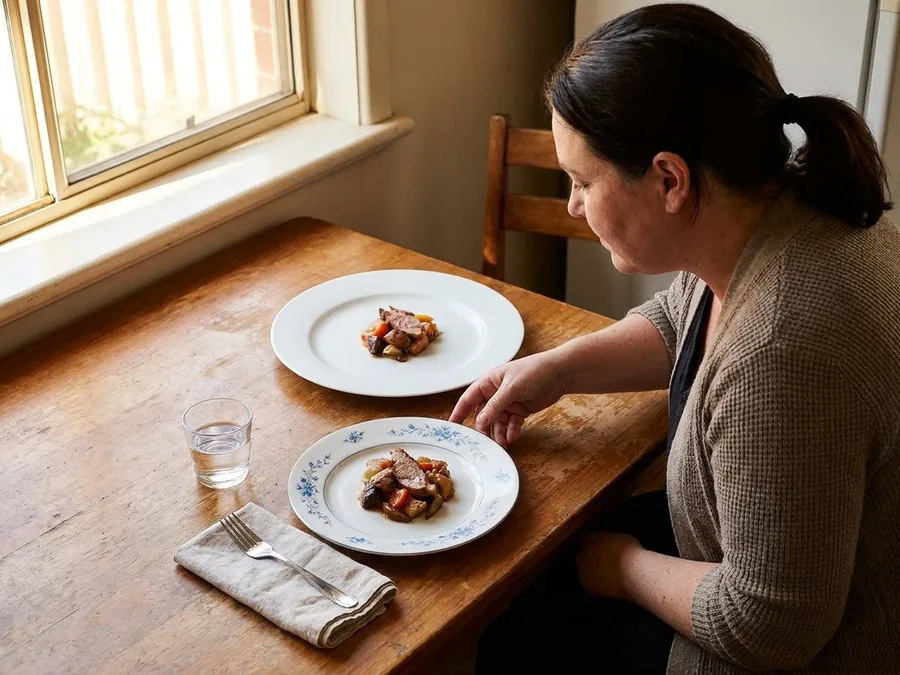
Dinner plates in that home measured 9 inches across. The standard dinner plate today is 12. Three extra inches of diameter is roughly 50 percent more surface area, which is why nobody in that kitchen ever felt shortchanged.
Behavioral nutrition researchers keep documenting the portion size effect: people eat more when more is served, independent of actual hunger. The plate is the sign the brain takes in before the stomach reports anything. A large restaurant portion in 1961 would be a small at any chain today.
The old size is still out there. Fiesta ware, Melmac and sprigged white china turn up in antique shops, or you can order a plain 9-inch set for about $30.
The trick is that a small plate read as full, so nobody got up hungry and nobody felt cheated. The 9-inch plate was the right size. It stayed that way for decades, until resizing it became profitable.
Portion Cues — At a Glance
🍽️ Plate math
Area = πr²; 9in→63.6 sq in, 12in→113.1
🥦 The cheat move
Fill half with veg first; protein and starch share the rest
⏭️ Skip this if
You eat mostly pre-portioned meals or already use small bowls
⚠️ Common mistake
Piling high defeats it — keep servings level, not heaped
🚫 What it won't fix
Late-night snacking or sweetened drinks — plate size only sets meal portions
Key limit
Only works if you don't go back for seconds — the plate changes the cue, not the habit.
4. Three fixed meal times trained the appetite
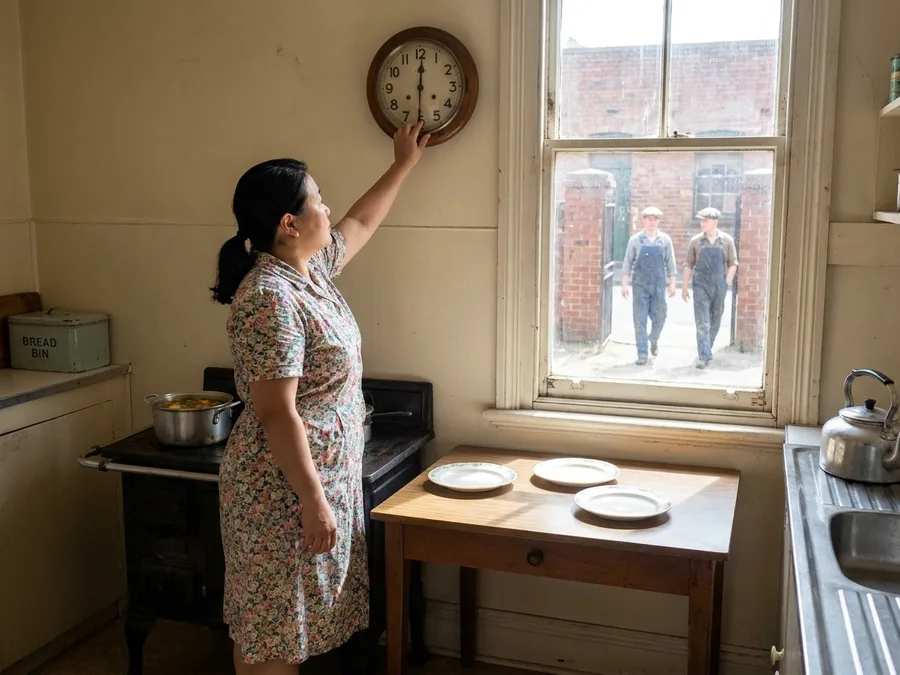
Think about the last time you ate lunch because you were hungry at noon, not because it was noon. That predictability used to be built into the day, and it changed what hunger felt like.
In 1958 the noon whistle at the plant blew at exactly 12:00, and women at home fed the children at that same hour. Dinner came at 6, breakfast at 7. Between those three fixed points, nothing. Not because of willpower, but because eating between meals hadn’t been normalised yet.
A 2019 paper in Cell Metabolism found that eating on a steady timetable lowered total intake and improved metabolic function with no restriction on what was eaten. The body settles around predictability. Someone raised on that rhythm would have found the whole idea of intuitive eating confusing, because she was simply hungry at noon and 6, same as yesterday.
Then SlimFast arrived in 1977, the year of the low-fat guidelines, promising a shake in place of a meal. The meal replacement industry is now worth $16 billion. A fixed schedule cost nothing and needed nothing. The product that replaced it comes with a monthly delivery option.
Resetting the timing takes about a week and not a single food change. Anchor breakfast first, same time every day for three days. Then anchor dinner. Lunch falls into place on its own, because the gap between two fixed points creates its own hunger.
💡 Tip: Set phone alarms for all three meals for the first week. Silent them by day eight, because by then your stomach is doing the reminding.
The snacking shift
5. Sugar was a treat, not a hidden ingredient

That snack category has a supply-side twin, and it’s the sugar nobody agreed to eat. The sugar bowl sat visible on the table in 1958, open and never hidden, and nobody counted grams. Added sugar per person ran about 23 pounds a year in 1960. Today it runs about 57.
The gap isn’t dessert. It’s bread, pasta sauce, peanut butter and salad dressing. A 1950s tomato sauce recipe reads tomatoes, garlic, olive oil, oregano. The label on a leading jarred brand today lists 22 ingredients, including high fructose corn syrup. N calls for putting that in the family recipe, and because it didn’t exist yet.
Reading the first five ingredients on the back and ignoring the front of the pack will strip more sugar out of a weekly shop than any dessert rule. Start with those four categories and work backwards through the trolley.
When sugar is rare it gives real pleasure. Jean’s daughter still remembers the birthday cake, not for its abundance, but because there was just one, and it was worth remembering.
💡 Tip: The cheapest way to strip hidden sugar out of a weekly shop: read the first five ingredients, ignore the front of the pack, and start with the four categories named above.
⚠️ COMMON MISTAKE
Don't blame dessert
If you cut cake and cookies but still eat bread, sauce, peanut butter, and dressing without checking labels, you've missed the biggest source of added sugar in your day. Start with the packaged savoury items, not the sweet ones.
6. Drinks were water, milk and a Friday Coke
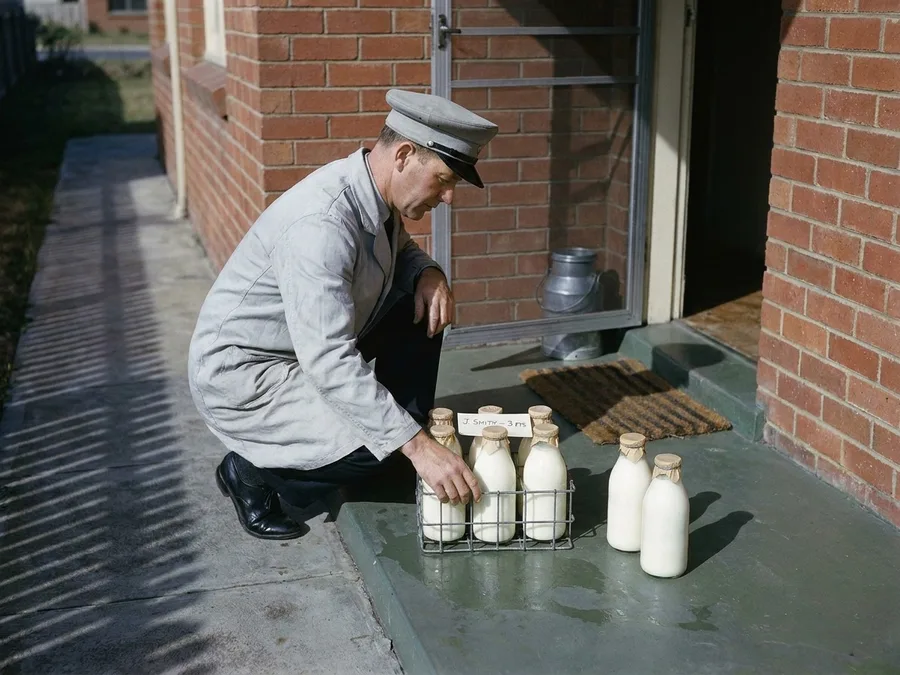
Other habits on this list came from the pantry, but the real surplus was often in the glass. Not everything came from a bottle with a label, though. The milkman came on Tuesdays and Thursdays – glass bottles, paper caps, the family name on the order. Children got milk at dinner, adults got water, and coffee was poured black or lightened with a splash of genuine cream from that same glass bottle.
Soda existed. A 6.5-ounce Coca-Cola was the sole option on offer, and it appeared on Friday nights. Today’s standard 20-ounce bottle is 240 calories. The global beverage industry – soft drinks, energy drinks, sweetened coffees, flavored waters – is worth over $300 billion. Water cannot be trademarked and milk cannot support that kind of industry.
So stepping a daily drink down without going cold turkey to water is a three-week swap. Week one: halve the size. Week two: switch to the diet version or add a daily drink to water, a splash of juice. Wake up with lemon or black coffee if you need the ritual.
7. Coffee was two calories until it became dessert

The 1961 coffee break lasted 15 minutes and involved a percolator and a ceramic mug. Coffee was simply coffee. Two calories per cup.
Starbucks opened in 1971. By the late 1990s the coffee drink had been invented – beverages with coffee on the label that run 300 to 600 calories. A grande pumpkin spice latte holds more calories than a complete 1960s lunch. Jacqueline Kennedy drank black coffee throughout the day, according to her personal secretary, Mary Gallagher. Not as a diet strategy. Just as coffee.
The calories live in the syrup and the milk, not in the coffee itself, so a small unsweetened latte or an Americano with a splash of cream still feels like a treat and lands closer to 30 than to 300.
💡 Tip: The calories live in the syrup and the milk, not the coffee. Order a small, unsweetened version with a splash of milk and it still feels like a treat.
Then vs. Now — What Actually Changed
1950s–60s
- 9-inch plates, full at every meal
- Two eggs and toast for breakfast
- Water, milk, black coffee, Friday Coke
- Butter and lard used daily
- Movement built into the whole day
Today
- 12-inch plates, same 'full' feeling
- $35 billion breakfast-on-the-go market
- 300–600 calorie coffee drinks
- Fat replaced with sugar across the aisle
- $35 billion fitness industry sold as a monthly fee
8. Movement came from the day, not the gym

Sitting still is the opposite of that kitchen work, and it is where the modern day went wrong. In 1960 the term exercise described something soldiers did. For everyone else, it had no category. You didn’t work out; you just lived.
A housewife’s morning meant making beds, hauling washing out to the line, then the butcher, the baker and the produce stand, arms loaded the whole way. Dinner meant two hours on her feet. None of it was scheduled. None of it was called a workout.
Research in the journal Science on NEAT – non-exercise activity thermogenesis – shows ordinary daily movement can produce differences of as much as 2,000 calories a day from one person to the next. That is the gap between a day in that a chair and a day on your feet, and it was closed before anyone thought to charge for it.
Fitness in America has grown into a $35 billion business, charging a monthly fee for what the neighborhood once provided free – Jean carried groceries home from the butcher and her neighborhood was her gym.
This is the point that translates worst to a desk job. An hour-long walk burns roughly 250-350 calories – real, but not the same as a day on your feet. The honest substitution is to add movement in small, frequent pieces: stairs instead of the lift, a ten-minute walk after lunch, and standing for phone calls.
💡 Tip: A 20-minute walk replaces some of the walking, not all of the standing, lifting, and carrying. Add a basket of laundry carried up the stairs and you're closer.
9. Cooking from scratch capped calories by default

That walking ended at the kitchen, where the work was its own protection. The 1960 pantry stocked flour, butter, eggs, potatoes, onions, and whatever was in season. Soup came from yesterday’s chicken carcass, not from a can. There was no high fructose corn syrup in the pot roast because she didn’t put it there, and no modified starch in the soup because it started as bones.
A study in Public Health Nutrition found that people who cook at home most frequently eat significantly fewer calories per meal than those who rely on prepared food. Not from effort, but because meals made from scratch pack fewer calories per bite than their commercial counterparts. Wonderbread lists over 30 ingredients today. Bread in 1955 had four: flour, water, yeast, salt.
The catch is that this ran on hours of unpaid labor, and nobody should pretend otherwise. The 20-minute version that keeps the effect: cook one big pot of something on Sunday, eat it twice in the week, and keep the pantry stocked with the four-ingredient basics so the default is cooking, not ordering.
What Jean's daily food cost
None of it required a subscription, a label to read or a number to count.
10. Real fat was eaten daily, and the swap backfired
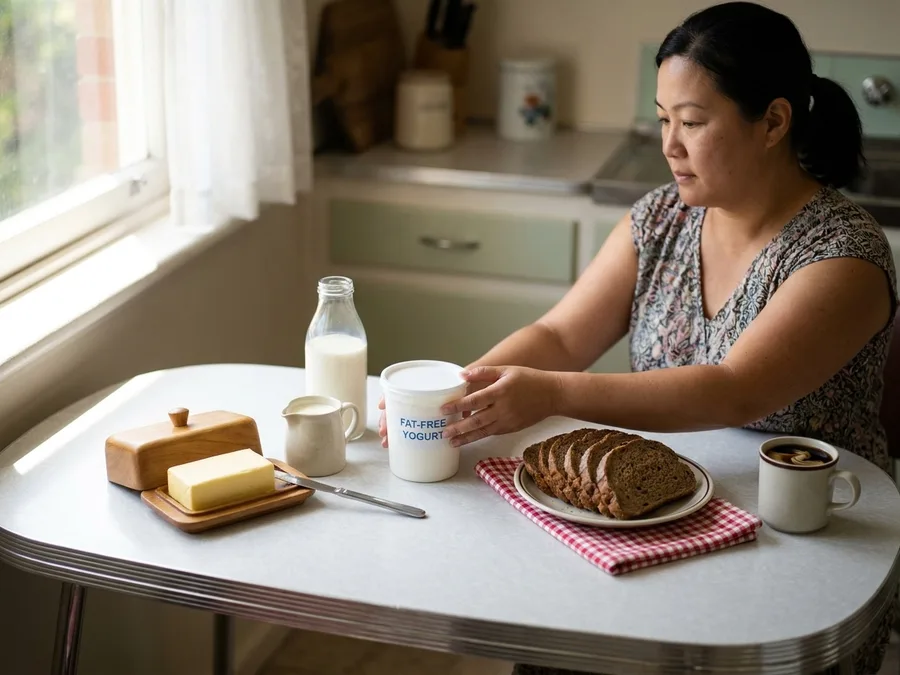
Go back to the dress that fitted at 22 and still fitted at 50, and remember what went into the pan that fed it. Butter went into the pan, lard into the pie crust, whole milk into everything, and cream into the coffee – every day of adult life, with that same dress still hanging in the closet.
In 1977 the US Senate Select Committee on Nutrition published guidelines recommending Americans cut fat intake. The food industry’s response was not to improve the food. It was to swap fat for sugar, since fat is what carries taste and the gap had to be filled by something. Fat-free cookies, skim milk, margarine, fat-free yogurt, light spreads. Within 15 years obesity rates began climbing, a line that hasn’t stopped since. The low-fat and diet category is now worth about $250 billion a year.
What this does not license is treating butter as a free food. The argument is about the substitution – replacing fat with sugar made things worse, not better. Use real butter, real cream, and whole milk in normal amounts, and stop buying products that promise the fat was removed.
💡 Tip: The next time a label says 'fat-free', read the ingredients. If sugar, corn syrup or maltodextrin is in the top three, put it back and buy the regular version instead.
Smoking, scarcity and pressure: what not to copy
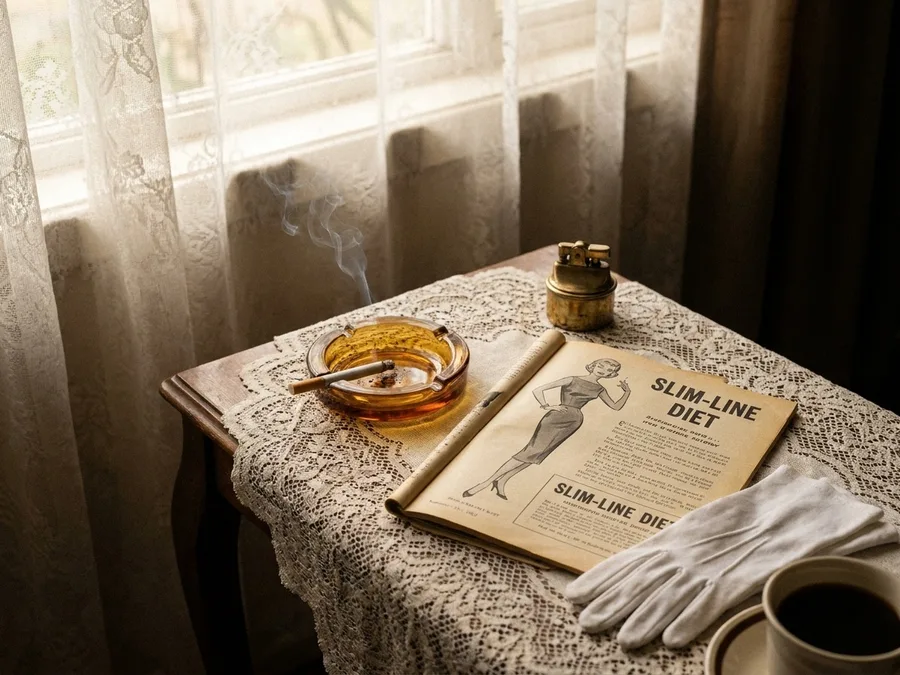
Before you take any of this home, it’s worth being honest about what that generation was not. Jean’s slimness was real. So was the cost of it.
Smoking was ordinary then, and it dulled appetite. That’s a price the decade paid, not a trick worth borrowing. Food wasn’t always plentiful either. Some of the thinness in those photographs was scarcity dressed up as discipline. And the pressure to hold a 23-inch waist did its own quiet damage, the kind nobody wrote down.
That’s the part the dress measurements hide. A wedding dress measured once in a Dayton church in 1961 is evidence of nothing about a woman’s health. It’s evidence that she was 22.
So hold the two ideas together. The habits on this list are worth restoring because they’re ordinary and gentle. The full picture of 1959 is not, and nobody should be aiming at it.
If you have any history of restrictive dieting or disordered eating, treat all of this as history rather than a plan. Nothing here is meant to be a rule you obey. If a habit starts to feel like something you can’t break, put it down and talk to a doctor or a registered dietitian. That’s not a failure of willpower. That’s the right call.
Everything worth keeping is on the other side of this entry, and it all looks a lot kinder than what came with it.
Which habit to restore first, and in what order

So after all that history, where do you actually start? Breakfast, then plate size, then the drink, then meal timing. That order isn’t arbitrary.
Breakfast gives you the most back for the least effort. Two eggs and toast don’t have to cost 20 cents, but the effect is the same: it keeps you steady until lunch, so the rest of the day starts from a calmer place. No equipment needed beyond a pan and five minutes. Plate size comes second because it’s a single purchase that quietly shrinks every dinner with no willpower involved.
The habit should also match your situation, and this is where most plans fall apart.
Restore the snacking rule first. The kitchen is three steps away and boredom is the trigger, not hunger. Desk job? Movement is your job, not the gym. A 20-minute walk after lunch and stairs instead of the lift, every day, is the whole thing. If you cook for the family, start with plate size, because you’re the one holding the spoon. And if you work shifts, timing is what will do the most for you, even when the hours aren’t 7, noon and 6.
Then run a seven-day test that changes exactly one thing. Judge it by how the week felt, not by the scale. If 3 p.m. got easier, or you stopped thinking about the cupboard between meals, you’ve found the one to keep.
What Jean’s dress can and can’t tell you
The dress is a nice story, and it’s a true one. But it can’t tell you whether Jean was healthy, or happy, or whether her waist had anything to do with the way she ate. What it can tell you is that ten ordinary habits kept a generation slim without anyone naming them, and that most of those habits cost nothing.
What changed between Jean’s kitchen and yours was not what the human body needs. What changed was who got paid once those needs were swapped for products that could be manufactured and branded. The discipline gap is real, but the reason it exists is that you’re fighting a system designed to make discipline fail and then selling you the products to almost manage it.
Pick one habit. Run it for seven days. Judge it by how the week felt, not by the scale, and keep the one that made the week easier.
Pick one habit and run it for seven days
Choose the one thing from this list that fits your week — breakfast, plate size, the drink, or timing — and test it for seven days. Judge it by how the week felt, not by the scale.
